Forty-eight terms, defined the way we use them.
Ask about a term
If a supplier has used a word at you that you cannot pin down, send it over. We will tell you what it means and, occasionally, what it is being used to avoid saying.
From the yard
The glossary
- Backhaul
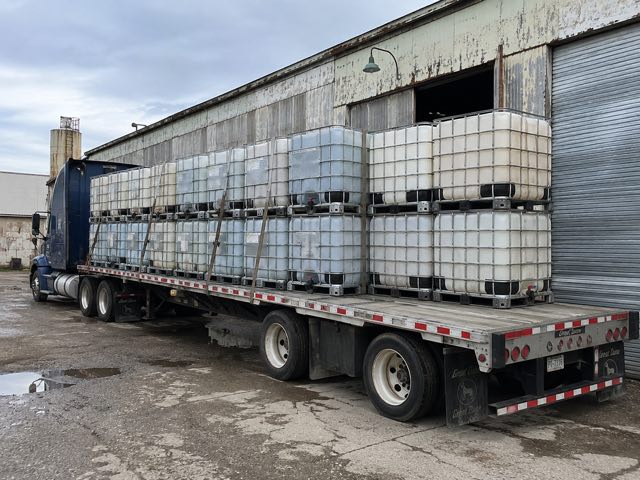
- Loading a truck for the return leg of a delivery run, usually with collected empties. About 71% of our outbound flatbed miles come back loaded.
- Base ring
- The bottom steel ring of an IBC cage. It sits in whatever the pallet collects and corrodes from the inside out — the single most common reason a cage is rejected.
- Bonding and grounding
- Electrically connecting a container and receiving vessel to each other and to earth so static cannot accumulate during transfer. Essential for flammable liquid and not achievable with a plain composite IBC.
- Borescope
- A small camera on a flexible probe used to inspect a bottle interior through the lid opening, principally for stress-crazing at the shoulders.
- Bottle
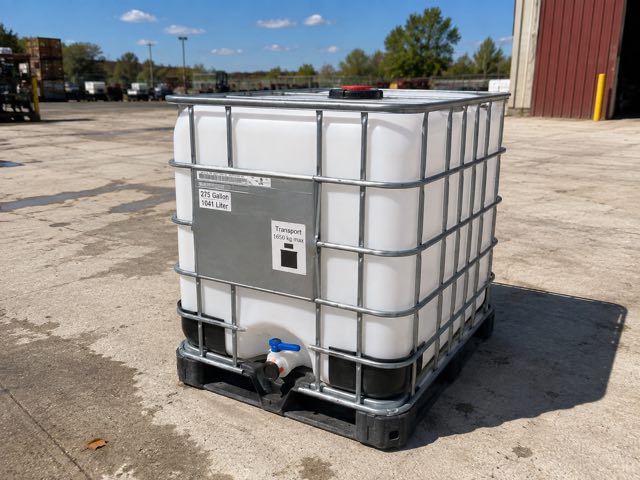
- The blow-moulded HDPE inner receptacle of a composite IBC. Roughly 55 lb on a 275 gallon unit.
- Brim capacity
- The volume a container holds filled to the very top, as distinct from nominal capacity. A 275 gallon tote brims at about 288 gallons.
- Bunding
- Secondary containment — a sump or bunded platform sized to hold the contents of the largest container plus freeboard, in case the primary container fails.
- Buttress thread
- The coarse asymmetric thread used on IBC outlets and lids. S60x6 is the standard 60 mm outlet thread; it is not NPT and not a garden hose thread.
- Cage
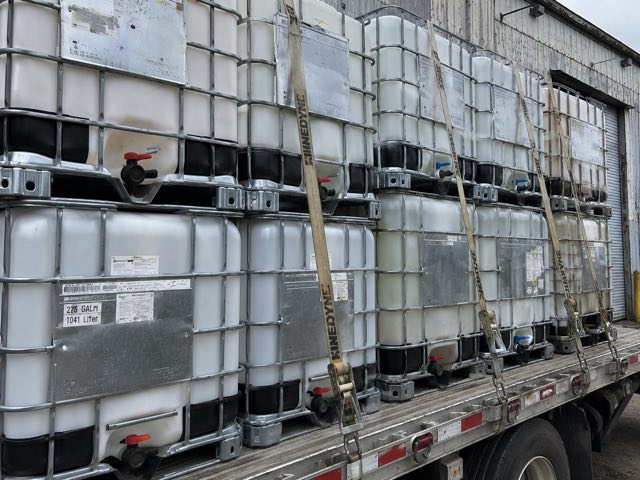
- The welded galvanised steel frame surrounding the bottle. Carries the stacking load and protects the bottle. About 62–78 lb depending on size.
- Camlock
- A quick-connect coupling using cam levers. Type F is the common male adapter fitted to IBC outlets for pump and hose connections.
- Caustic circuit
- The heated sodium hydroxide solution loop used in a professional wash bay to saponify fats and lift cured residue. Ours runs at 160 °F and is recovered through a three-stage separator.
- Closed loop
- A wash system in which spent solution is cleaned and returned rather than discharged. Ours recovers 94% of circuit water, cutting fresh-water use to roughly seven gallons per container.
- Composite IBC
- The standard caged tote: a rigid plastic inner receptacle inside a rigid outer casing. Designated HA in UN marking.
- Coalescing plate pack
- A separator stage that encourages small oil droplets to merge and rise for skimming. The reason oil-history containers are economic to wash.
- Design type
- The certified configuration a UN-rated container was tested as. Moving a bottle into a different cage breaks the design-type chain and voids the rating.
- Diversion rate
- The share of inbound mass that leaves as product or recovered feedstock rather than as landfill waste. Ours is 98.6%.
- EPDM
- Ethylene propylene diene monomer — the standard gasket rubber for IBC outlets. Good with water, acids, alkalis and steam; poor with oils and hydrocarbons, where nitrile or Viton is used instead.
- Fill height
- The depth of liquid in a full container, as distinct from overall height. About 38 inches in a 275 gallon tote against 46 inches overall.
- First flush
- The initial runoff from a roof at the start of a storm, carrying accumulated dust and debris. A first-flush diverter dumps it before the clean water reaches a rainwater tank.
- Four-way entry
- A pallet base that a forklift can enter from any of four sides. Standard on composite, plastic and steel IBC bases, though pocket widths vary between makers.
- Freeboard
- The margin above the required containment volume in a bund, allowing for rainfall and for the displaced volume of the container itself.
- Granulation
- Shredding and grinding HDPE into regrind for re-moulding. Our plant runs at 1,100 lb per hour and is the last step before a container leaves the loop.
- Grade
- A supplier-defined condition rating for a used container. There is no industry standard; ask any yard for their written definitions.
- Gross mass
- The total weight of container plus contents. Marked in kilograms on the UN plate as the maximum permitted figure.
- HDPE
- High-density polyethylene, the resin used for IBC bottles. FDA-compliant for food contact from manufacture, resistant to most water-based chemistry, attacked by strong oxidisers and swelled by many solvents.
- Head pressure
- The static pressure at the outlet produced by the column of liquid above it. About 1.37 psi for a full 275 gallon tote; each foot of elevation adds 0.43 psi.
- IBC
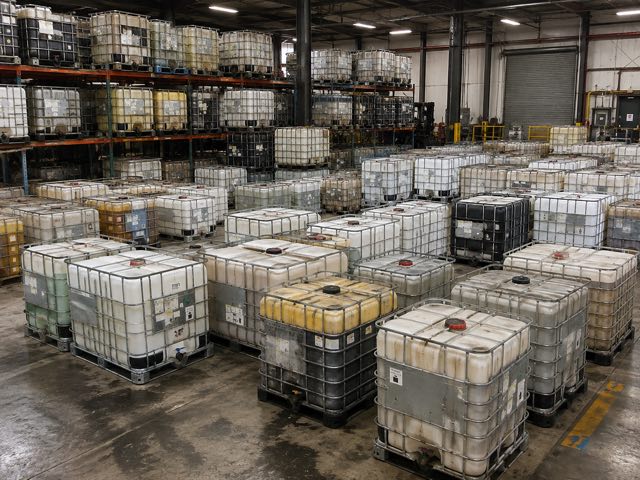
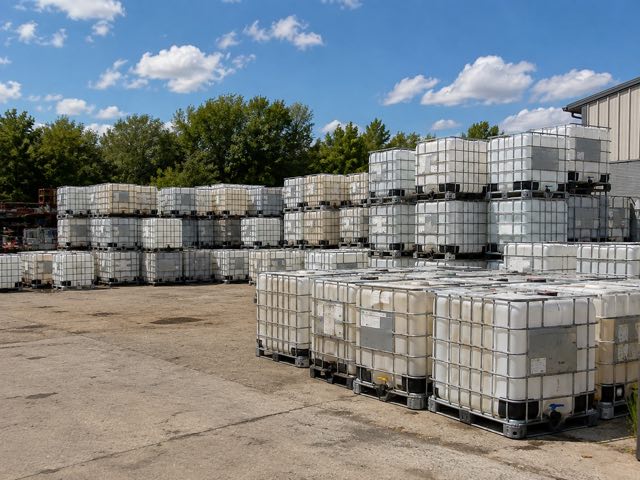
- Intermediate bulk container — anything between a drum and a fixed tank, typically 120 to 793 gallons. The caged composite version is what most people mean by "tote".
- Leak test
- Pressurising a sealed container, typically to 3 psi, and monitoring for decay. Required at least every 2.5 years for regulated liquid service.
- Liftgate
- A hydraulic platform on the back of a truck for lowering freight to ground level where no forklift is available. Handles up to four totes at a time.
- Load centre
- The horizontal distance from the fork face to the load’s centre of gravity. Forklift capacity plates assume 24 inches; a 48-inch-deep tote pushes it further out and reduces effective capacity.
- Manifold
- Plumbing several containers to a single draw point so they behave as one tank while sharing a level.
- Nominal capacity
- The stated working volume of a container — 275, 330, 550 gallons — as opposed to its brim capacity.
- Packing group
- The hazard tier a container is rated for. X covers groups I, II and III; Y covers II and III; Z covers III only.
- Periodic inspection
- The full five-yearly examination required for composite IBCs in regulated liquid service under 49 CFR 178.813.
- Prior-contents record
- Written documentation of what a used container previously held, and where possible the shipper. The single most important document when buying used.
- Rebottling
- Fitting a new virgin HDPE bottle into a reclaimed, inspected cage and pallet. Avoids roughly 78 lb of virgin steel per container.
- Reconditioning
- Washing, inspecting, re-gasketing and leak-testing an existing container without replacing the bottle. Avoids roughly 133 lb of virgin material per container.
- Regrind
- Granulated post-use HDPE sold as feedstock. Ours goes to moulders making drainage pipe, wheel chocks and pallets.
- S60x6
- The 60 mm coarse buttress thread standard on IBC outlets. Adapters convert it to garden hose, camlock, NPT or barb.
- Saponification
- The chemical conversion of fats and oils into soap by hot alkali. Why a caustic circuit removes oil residue that pressure washing merely relocates.
- Specific gravity
- A liquid’s density relative to water. Multiply by 8.34 lb per gallon to get the real weight of your contents — the figure most often skipped before a lift goes wrong.
- Stacking load
- The maximum superimposed weight a container may carry when stacked, marked in kilograms on the UN plate.
- Stress-crazing
- Fine white networks of micro-cracks in HDPE caused by repeated flexing under load. The failure mode that ends a bottle’s working life, usually after six to eight cycles.
- Tare weight
- The empty weight of the container. About 125 lb for a 275 gallon composite IBC.
- Toll service
- Processing containers you own and returning them to you, as distinct from selling you stock. Applies to our washing, reconditioning and inspection services.
- Triple rinse
- Three complete fill-and-drain cycles with fresh solution each time, so residual concentration falls geometrically rather than being redistributed.
- UN plate
- The marked plate on a certified container recording design type, packing group, dates, manufacturer and load limits. Illegible plate, no certification.
- Vented lid
- A lid with a breather that prevents a vacuum forming when liquid is drawn from a sealed container. Sixteen dollars; prevents a permanent collapse.
B
C
D
E
F
G
H
I
L
M
N
P
R
S
T
U
V
Frequently asked
What is the difference between an IBC, a tote and a tank?
In practice the first two are the same thing. IBC is the formal term — intermediate bulk container — and tote is what everyone on a yard actually says. A tank is different in kind: it is fixed or semi-fixed, usually much larger, and is not designed to be moved full on a pallet. The whole point of an IBC is that it sits between a drum and a tank, holding roughly five drums' worth while still handling like a pallet.
What does 'Grade A' mean when applied to a used tote?
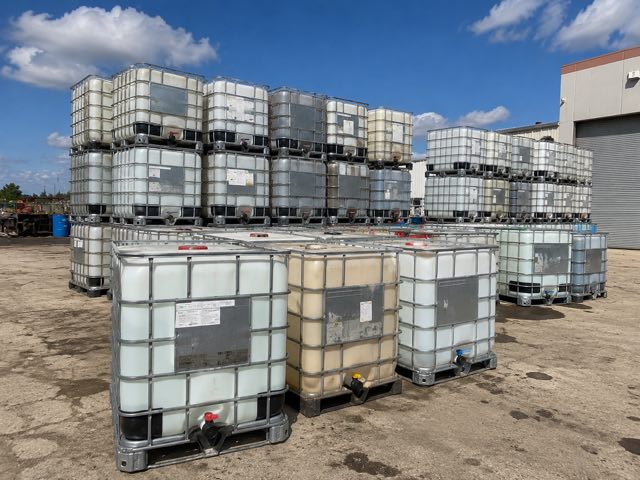
In our yard it means washed on a caustic circuit, free of residue and odour, with a straight cage and a documented prior-contents record. Grade B is rinsed rather than washed and typically shows staining, residual odour or minor cage damage. Grade C is sold as-is for non-critical duty. Be careful with these terms elsewhere — they are not an industry standard, and a listing that says Grade A without defining it is telling you nothing.
What is rebottling?
Fitting a brand-new HDPE bottle into a reused steel cage and pallet. It is the answer when the cage is sound but the bottle is not, or when a customer needs a virgin interior without paying for new steel. It keeps roughly 60 lb of galvanised steel in service per unit and removes the prior-contents question entirely, which is why biotech and food customers buy far more rebottled stock than anyone else.
What is a UN plate and why does it matter?
The stamped or riveted plate on the cage that records the design type, materials, year of manufacture and the tests the design passed. It matters for one reason: transporting a hazardous liquid on a public road requires a container with a valid certification and a current periodic inspection. For a non-hazardous liquid sitting in your own yard it is informational rather than binding.
What does 'toll washing' mean?
Washing a container you already own and returning the same container to you, rather than swapping it for one of ours. Manufacturers with asset-tagged fleets almost always want toll work, because the unit number on the way out has to match the unit number on the way in. It runs about $38 a unit on standard industrial duty and it will frequently turn a Grade B container back into a Grade A one.