Tare, gross, head pressure and the arithmetic nobody does.
Ask an engineering question
Rack capacity, forklift derating, head pressure, freight class — put the question in the message field and someone who has actually loaded these will answer it.
Gross weight = tare + (gallons × 8.34 × specific gravity). Almost every handling failure with IBC totes traces back to someone using the water figure for a liquid that is not water. A 275 gallon tote of 93% sulphuric acid grosses 4,321 lb — nearly twice what people assume when they see “275 gallon tote, about 2,400 pounds.”
From the yard
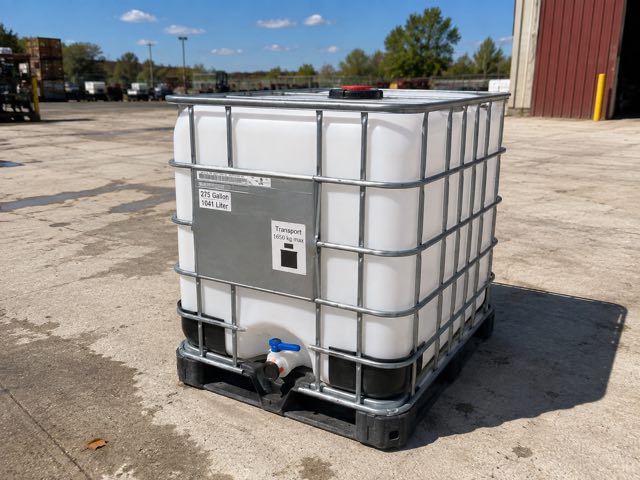
Dimensions and weights by capacity
| Capacity | L × W × H (in) | L × W × H (mm) | Fill height (in) | Tare (lb) | Net water (lb) | Gross water (lb) | Head at outlet (psi) |
|---|---|---|---|---|---|---|---|
| 120 gal | 40 × 32 × 38 | 1016 × 813 × 965 | 30 | 78 | 1001 | 1079 | 1.08 |
| 180 gal | 42 × 36 × 42 | 1067 × 914 × 1067 | 34 | 96 | 1501 | 1597 | 1.23 |
| 275 gal | 48 × 40 × 46 | 1219 × 1016 × 1168 | 38 | 125 | 2293 | 2418 | 1.37 |
| 330 gal | 48 × 40 × 53 | 1219 × 1016 × 1346 | 45 | 145 | 2752 | 2897 | 1.62 |
| 350 gal | 48 × 40 × 56 | 1219 × 1016 × 1422 | 48 | 152 | 2919 | 3071 | 1.73 |
| 550 gal | 48 × 48 × 68 | 1219 × 1219 × 1727 | 59 | 228 | 4587 | 4815 | 2.13 |
Five checks before you buy
Convert to real weight
Take the specific gravity from the safety data sheet, not from memory. Gross = tare + (gal × 8.34 × SG). Write it down; you will need it three more times.
Check the forklift at the actual load centre
Capacity plates are rated at a 24-inch load centre at a stated mast height. A tote is a 48-inch-deep load, so your effective load centre is further out and your capacity is lower than the badge. Derate before you lift.
Check the rack beam pair
Two 275s per bay is 4,836 lb. Compare against the rack capacity plate per beam pair, not per bay level. If the plate is missing, get the rack assessed rather than guessing.
Check the floor
A full 550 concentrates 4,815 lb over 16 square feet through four pallet feet. Mezzanines, suspended slabs and older timber floors need checking; ground-bearing concrete generally does not.
Check the clearance path
Doorway width, doorway height, lift height in transit, turning diagonal (62 inches on a 48 × 40 unit) and any overhead services along the route.
Specific gravity of common contents
| Liquid | SG | 275 gal gross (lb) | 330 gal gross (lb) |
|---|---|---|---|
| Diesel / heating oil | 0.85 | 2,074 | 2,484 |
| Vegetable oil | 0.92 | 2,235 | 2,677 |
| Water | 1.00 | 2,418 | 2,897 |
| Beer / wort | 1.04 | 2,510 | 3,007 |
| Liquid fertiliser (UAN 32) | 1.32 | 3,152 | 3,777 |
| Cane syrup | 1.42 | 3,381 | 4,052 |
| Sodium hydroxide 50% | 1.53 | 3,633 | 4,354 |
| Sulphuric acid 93% | 1.83 | 4,321 | 5,180 |
| Zinc chloride solution | 2.01 | 4,734 | 5,675 |
The rule of thumb worth memorising
Dimensions & weight FAQ
How do I calculate the gross weight of a filled tote?
Gross = tare + (gallons × 8.34 × specific gravity). A 275 gallon tote with a tare of 125 lb holding a liquid of SG 1.25 grosses 125 + (275 × 8.34 × 1.25) = 3,242 lb. Always use the actual specific gravity from the safety data sheet rather than assuming water, and always check the result against your forklift rating at the load centre you will actually use.
What is fill height and why does it matter?
Fill height is the depth of liquid, not the height of the container: about 38 inches in a 275 gallon tote against an overall height of 46. It matters for gravity feeds, because head pressure is a function of liquid column height. A full 275 gives roughly 1.37 psi of head at the outlet — enough to fill a drum, not enough to run a spray nozzle.
What freight class are IBC totes?
Empty IBCs typically fall in NMFC class 150 to 175 based on density, since they are bulky and light. Filled containers move by weight and are classed on the commodity inside rather than the container. Palletised empties are usually stretch-wrapped four to a pallet position and double-stacked, which improves density and can drop the class.
Can pallet racking hold a full IBC tote?
Standard racking often cannot without checking. A pair of 275 gallon totes at 2,418 lb each is 4,836 lb per bay, which exceeds the rated beam capacity of a great deal of light-duty racking. Get the rack capacity plate, work out load per beam pair, and if the plate is missing, have the rack assessed. This is the failure mode with the worst consequences on this entire page.