Cut, plumb, weld, stencil, ship
Book custom fabrication
One written channel for everything: quotes, bookings, freight and questions. A person reads every one of these.
Fabrication is quoted per job, typically $120–$900 on top of the container cost, with a one to three week lead time. Common work includes manifolding multiple totes into a single draw point, cutting access hatches, welding bunded steel frames, fitting sight tubes and pumps, inverting containers into hoppers and stencilling asset identification.
The work we take on
Manifolded arrays
Two to eight containers plumbed to a single draw point with balanced levels, isolation valves and a common vent. The standard answer when you need 2,000 gallons but only have a 48-inch door.
Bunded steel platforms
Welded secondary containment sized to the largest container plus freeboard, forkable, with a sump drain and a grate deck. Built to your footprint rather than a catalogue size.
Cut-down and open-top tanks
Containers cut to a working height with a folded and reinforced lip, cage retained for strength. Used for parts washing, dipping, mixing and soaking.
Hoppers and dry-goods conversions
Inverted containers with a cut cone and a slide gate on a mezzanine frame. Grain, aggregate, compost and pellet handling.
Pump and filtration skids
Container, pump, filter housing and plumbing assembled on a single forkable skid, wired and tested before it leaves.
Stencilling and asset marking
Cut-vinyl or sprayed stencil identification, hazard placarding, capacity marks and numbered asset tags applied to your scheme.
What we need from you
Five answers. Supply them with the first email and the job is quoted and scheduled without a single round trip.
A sketch, or a photograph of the space
Genuinely enough to start. Roughly half of what leaves the shop is somebody else's idea, briefed on the back of a bill of lading.
Rough dimensions and the constraint
Door width, ceiling height, the footprint you have. The constraint matters more than the wish list.
What liquid is involved, and what happens to it
It decides the container grade, the gasket material and whether the design works at all.
Whether it must be movable
Forkable, pallet-jackable or fixed. It changes the frame completely.
Your deadline, honestly
One to three weeks is normal. If it is tighter, say so at the start and we will tell you whether it is possible.
What is included
- Design review, and an honest opinion about whether the idea will work
- Cutting, folding and reinforcing lips on any cut bottle
- Welding, plumbing, manifolding and bunded steel frames
- Cut-vinyl or sprayed stencil identification and hazard placarding
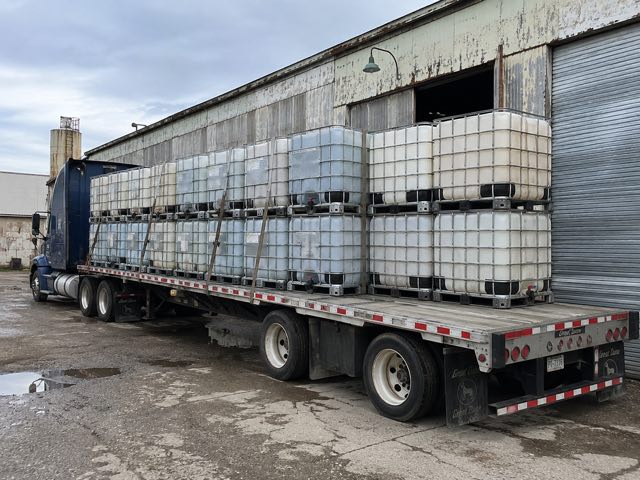
- Assembly and delivery on our own flatbeds where it fits
- A materials list and a fixed price before any work starts
What we will not do
- Anything that would be a pressure vessel — a cut bottle is not, and never will be
- Retaining a UN rating on a cut container; it is voided permanently and marked
- Building edible-garden planters from industrial-history containers
If it is not listed, ask
Turnaround, price and process
Indicative 2026 figures. Where a lane or a service level genuinely varies, the range is the range rather than the flattering end of it.
| Work | Typical price | Lead time | Delivered | Notes |
|---|---|---|---|---|
| Manifolded array, 4 totes | $600 – $900 + containers | 2–3 weeks | Assembled | Full-bore links, isolation valve per tank, common vent |
| Bunded steel platform | Quoted to footprint | 2–3 weeks | Assembled | Sump sized to largest container plus freeboard |
| Cut-down open-top tank | $180 – $320 | 1–2 weeks | Assembled | Folded and reinforced lip, cage retained |
| Hopper conversion | $420 – $650 | 2–3 weeks | Assembled | Cut cone and slide gate on a mezzanine frame |
| Pump and filtration skid | Quoted | 2–3 weeks | Wired and tested | Single forkable skid |
| Stencilling and asset marking | $18 – $45 per unit | 3–5 days | With the order | Your numbering scheme |
| Design review only | Free with an order | 2–3 days | — | Materials list, price and an honest opinion |
The problems this actually solves
"We need 2,000 gallons and a 48-inch door"
"The commercial version costs $900"
"Our last custom build clogged in three weeks"
What you end up holding
Reused containers live or die on documentation. This is everything that leaves here with the job, and how long we keep our copy.
| Document | Issued | We retain | What it is for |
|---|---|---|---|
| Materials list and fixed price | Before work starts | 5 years | No open-ended fabrication bills |
| Prior-contents note for the donor container | Every build | 5 years | Particularly for anything food-related |
| Rating-void marking | Any cut container | On the unit | So nobody later assumes it can carry regulated liquid |
| Plumbing or assembly diagram | Multi-part builds | 5 years | Siting and commissioning |
| Spares list | On request | — | So a failure is a ten-minute repair, not a return |
Custom Fabrication: FAQ
How do I brief a fabrication job?
A sketch is genuinely enough to start. Send a photograph of the space, rough dimensions, what liquid is involved and what you need to happen to it. Tomás comes back with a materials list, a price, a lead time and — importantly — an opinion on whether the idea will actually work. About one in eight briefs comes back with a better suggestion attached.
Can you work on containers I already own?
Yes. Ship them in or bring them to the yard. We will wash before fabricating if the prior contents warrant it, which is charged separately and is almost always worth doing before anyone takes a saw to a bottle.
Is a cut-down tote structurally sound?
With a folded and reinforced lip and the cage retained, yes, for open-top service at atmospheric pressure. What it is not is a pressure vessel or a transport container — cutting a bottle voids any UN rating permanently and we mark the unit accordingly.
Do you do one-offs?
Most of what we build is a one-off. There is no minimum and no premium for a single unit; the cost is the design time, which is the same whether you order one or five.
How do I brief a job without an engineering drawing?
A photograph of the space, rough dimensions, what liquid is involved and what you need to happen to it. That is enough for a materials list and a price. About one in eight briefs comes back with a better suggestion attached, because the shop has usually built something adjacent before.
Can you work on containers we already own?
Yes. Ship them in or bring them to the yard. We will wash before fabricating if the prior contents warrant it, charged separately, and it is almost always worth doing before anyone takes a saw to a bottle.
Is a cut-down container structurally sound?
With a folded and reinforced lip and the cage retained, yes, for open-top service at atmospheric pressure. What it is not is a pressure vessel or a transport container. Cutting a bottle voids any UN rating permanently, and we mark the unit so nobody assumes otherwise in three years.