The comparison, in numbers
| 55 gal drum | 275 gal IBC | 550 gal IBC | Fixed 5,000 gal tank | |
|---|---|---|---|---|
| Typical used cost | $45 | $165 | $285 | $9,500 installed |
| Cost per gallon | $0.82 | $0.60 | $0.52 | $1.90 |
| Floor area | 3.1 sq ft | 13.3 sq ft | 16.0 sq ft | 78 sq ft |
| Gallons per sq ft | 17.7 | 20.7 | 34.4 | 64.1 |
| Connections per 1,100 gal | 20 | 4 | 2 | 1 |
| Moved by | Drum dolly, one person | Forklift | Forklift, 6,000 lb | Not movable |
| Resale value | Low | Good | Good | Effectively none |
| Permitting | None | None | None | Usually required |
When a drum is genuinely right
- You need the liquid split into batches — different customers, different jobs, different formulations.
- The product has a short shelf life once opened, and you would rather open 55 gallons than 275.
- One person needs to move it without a forklift. A drum dolly and a strong back handles a 55; nothing handles a full tote by hand.
- The application is inherently open-top: parts washing, waste collection, soaking, composting.
- Total volume is genuinely below about 200 gallons, where a tote is more container than you need.
The five-drum test
Why totes dominate the middle
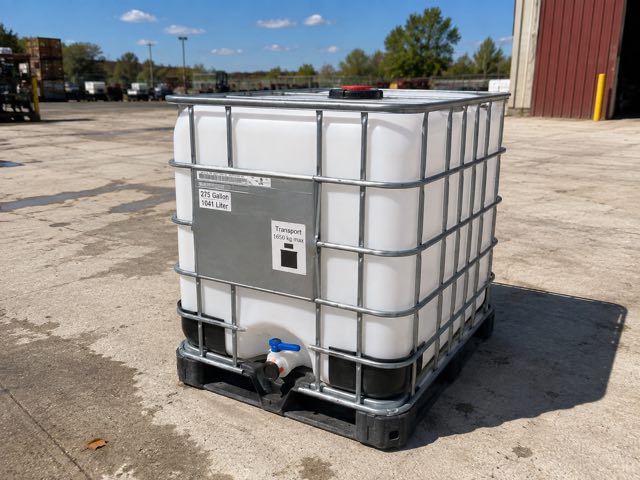
The 275 gallon tote occupies a very deliberate design point: the largest volume that a common forklift and a standard pallet position can handle. Everything about North American warehouse infrastructure is built around that footprint, which means a tote imposes almost no new requirements on a facility that already moves pallets.
Beyond the handling, three things make totes hard to beat between 200 and 10,000 gallons: one valve instead of many, an established secondary market that gives them real residual value, and the ability to scale by adding units rather than by re-engineering a system.
The scaling point matters more than people expect. Going from 1,100 gallons to 2,200 gallons with totes means buying four more containers. Doing it with a fixed tank means a new tank.
When a fixed tank finally wins
Somewhere above roughly 10,000 gallons of standing volume, or when you are receiving product by tanker rather than by pallet, a fixed vertical tank becomes the better answer. The per-gallon capital cost keeps falling, you stop paying for handling entirely, and tanker deliveries are cheaper per gallon than palletised freight.
What you trade is flexibility and residual value. A tank is a civil works project with permitting, secondary containment engineering, and an asset that is worth close to nothing if your process changes. A tote fleet can be resold, redeployed or returned to us for credit.
The hybrid most people end up with
Frequently asked
Is an IBC tote cheaper than drums?
Per gallon, substantially. A reconditioned 275 gallon tote at $165 works out at $0.60 per gallon; five 55 gallon drums holding the same volume cost about $225, or $0.82 per gallon, and take 15.5 square feet instead of 13.3. Drums win on divisibility and one-person handling, never on cost.
When should I move from totes to a fixed tank?
Around 10,000 gallons of standing volume, or as soon as you are taking delivery by tanker rather than by pallet. Below that the tote fleet is cheaper, more flexible and retains resale value. Above it the handling cost and the freight premium on palletised liquid start to dominate.
Can I use totes as a temporary tank farm?
Yes, and it is very common — manifolded arrays on a bunded platform are a standard fabrication job for us. Four to eight containers plumbed to a single draw point with isolation valves gives you tank-like behaviour with tote-like flexibility, at a fraction of the capital cost of a fixed installation.
What about stainless totes?
Stainless IBCs exist and are excellent for aggressive chemistry, high temperatures and food applications requiring hot cleaning. They also cost roughly ten times a reconditioned composite tote and are rarely available second-hand. For the overwhelming majority of applications, HDPE with the right gasket material is the correct engineering answer, not a compromise.
Written by the yard team at IBC Totes San Francisco. Last reviewed January 2026. Spotted something wrong? Tell us — we would rather fix it than defend it.