Answers written by people who wash these for a living.
Ask something we have not covered
If it is a good question we will answer it and then write it up. Put it in the message field.
Start with grades. Nearly every question that reaches our quote desk — is this food-safe, why is that one cheaper, can I use it for drinking water, will it hold my chemical — turns out to be a grading question wearing a different hat. Read that one first and the rest make more sense.
From the yard
Buying & choosing
IBC Tote Grades Explained
What separates an A from a B, and why a C can still be the right buy.
6 min · March 2026Rebottled vs Reconditioned
Which one your specification actually needs.
8 min · January 2026IBC Tote vs Drum vs Tank
Cost per gallon, floor space, handling and the crossover point.
Procedure & safety
How to Clean an IBC Tote
A triple-rinse procedure you can actually run in a back lot.
7 min · February 2026IBC Tote Safety Checklist
Eight checks that prevent nearly every IBC incident.
6 min · January 2026Outdoor Storage & UV Guide
UV, algae, freeze and ground prep for containers that live outside.
Reference material and real jobs.
A glossary of the forty-eight terms actually used on the yard floor, the full FAQ, and three write-ups of jobs that did not go entirely to plan.
Glossary
Forty-eight terms, defined the way we use them rather than the way a catalogue does.
REFERENCEFull FAQ
Twenty-four questions across buying, grading, freight, compliance and recycling.
CASE STUDIESThree real jobs
A brewery caustic loop, a vineyard harvest fleet and a municipal street-tree programme.
TOOLReuse Impact Engine
Model the avoided carbon, water, landfill and cost of your own container decision.
Frequently asked
What is an IBC tote?
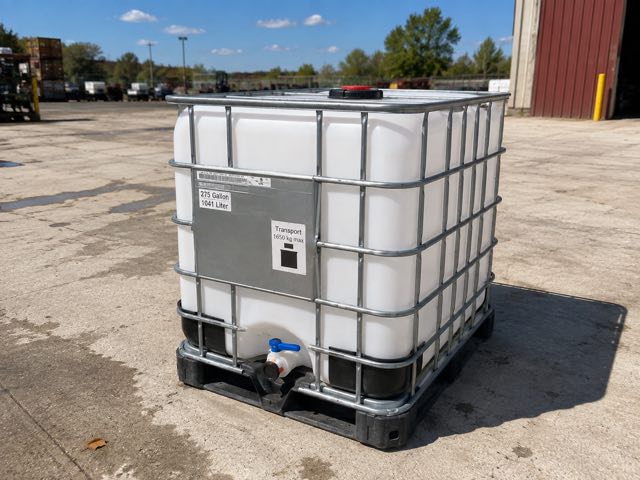
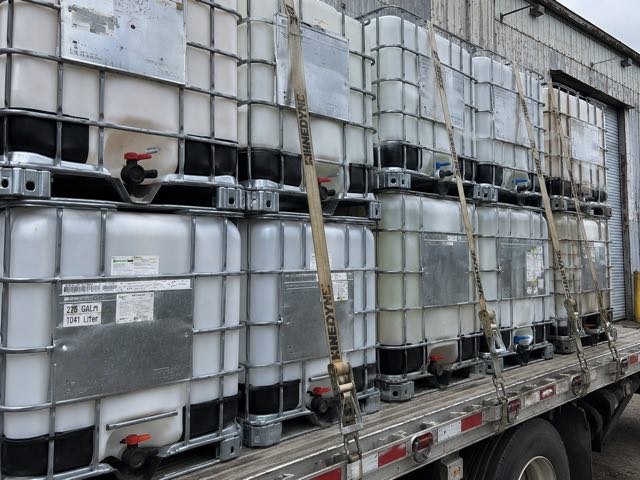
An intermediate bulk container: a moulded HDPE bottle inside a galvanised steel cage, sitting on a composite, steel, poly or wood pallet, with a fill port on top and a butterfly or ball valve at the bottom. The standard unit is 275 gallons — 1000 litres — on a 48 × 40 inch footprint, which is why it stacks, forklifts and ships like a pallet while holding roughly five drums' worth of liquid.
What is the difference between a reconditioned and a rebottled tote?
A reconditioned tote is the original bottle, washed, inspected, re-gasketed and leak-tested. A rebottled tote is a brand-new bottle fitted into a reused cage and pallet. Reconditioned is cheaper and fine for most industrial, agricultural and construction duty. Rebottled costs more and buys you one specific thing: a virgin interior with no prior-contents question at all, which is what GMP and food documentation chains usually need.
How do I know whether a used tote is safe for my product?
Two checks, in order. First the prior-contents record — if there is not one, walk away regardless of how good the container looks. Second, chemical compatibility of both the bottle and the gasket against your own product's safety data sheet, because HDPE tolerates far more than nitrile does. For food, beverage or potable use, add a dedicated food-line wash certificate and sanitise before first fill.
What do the markings on the side of a tote mean?
The UN plate encodes the design type, the materials, the year of manufacture, the country of approval and the pressure and stacking tests the design passed. It tells you what the container was certified to carry when new and when it was last inspected — not what is in it now. Periodic inspection is required for hazardous transport, and an out-of-date plate is a road-legality problem rather than a structural one.
Is it worth buying used rather than new?
For most duties, yes. A washed Grade A industrial unit costs roughly 55% less than new, performs identically for non-hazardous liquid and avoids about 235 lb of virgin material. New is worth paying for in exactly one situation: when an audit requires virgin resin end to end and no amount of documentation about a prior product will satisfy it. Everywhere else the used container is the better engineering decision as well as the cheaper one.