What sunlight actually does to HDPE
Ultraviolet light breaks polymer chains at the surface. The visible symptoms are chalking, a loss of gloss and a faint colour shift; the invisible one is a steady loss of impact strength, which is what matters when a forklift tine touches the container or it is dropped six inches onto a pad.
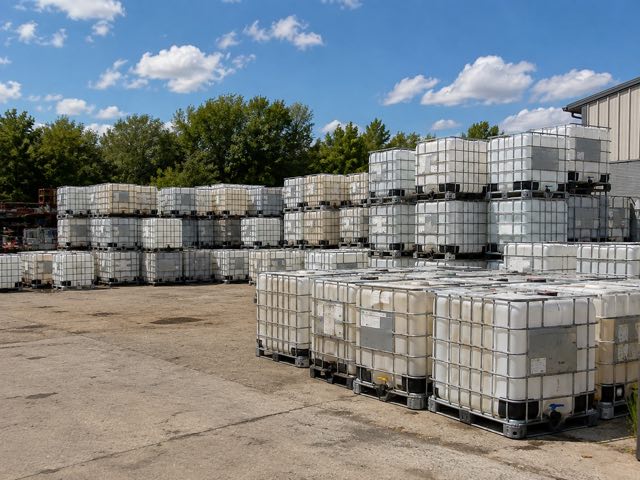
Bay Area sun is not Arizona sun, and coastal fog buys you real time. Even so, our field observation across returned containers is roughly four to six years of useful outdoor life uncovered against eight to twelve covered. That is a $48 cover buying four to six years.
Shade is not a cover
Algae: the problem people notice first
Translucent HDPE transmits enough light to support photosynthesis. Add water and any nutrient load — dust, pollen, roof runoff, a trace of the previous contents — and you have a functioning algae reactor within two to four weeks in warm weather.
- Block the light. A UV-opaque cover is the complete answer; painting the container is not, because paint on HDPE fails and flakes.
- Screen the inlet. Keeping organic debris out removes the nutrient supply.
- Turn the water over. Stagnant storage grows more than water that is drawn and refilled.
- Clean between seasons. A hot rinse and a chlorine cycle resets the container; leaving a growth to overwinter guarantees a faster start next year.
Ground preparation
- Minimum bearing2,418 lb over 13.3 sq ft (275 gal, water)
- Acceptable baseConcrete pad, compacted gravel, steel stand
- Not acceptableSoil, decking, pavers on sand, timber sleepers
- Level toleranceWithin 1 in across the footprint
- Elevation for gravityEach foot adds ≈ 0.43 psi at the outlet
- DrainageSlope away; standing water corrodes base rings
- AccessForklift clearance on at least two sides
The single most common outdoor failure we see is a container placed on soil that settles unevenly over a winter. The pallet twists, the bottle no longer sits square, and the base cracks at a corner. Compacted gravel costs almost nothing and prevents it entirely.
Freeze, wind and the rest of the weather
In San Francisco proper, freezing is rarely the issue — the risk climbs quickly inland toward Livermore, Sacramento and the foothills. Water expands about 9% on freezing, and a full container has nowhere to put that expansion except into the walls.
- Leave 10% headspace in any container that may freeze, and drain taps, valves and exposed lines in December.
- An insulated tote jacket ($140) or a thermostatic heater blanket ($285) is worth it for a container that must stay liquid through winter.
- Wind matters for empty containers: an empty 275 is 125 lb with a large sail area and will move across a yard in a Bay Area winter gale. Strap or nest them.
- Keep containers off the drip line of a roof. Constant dripping accelerates base-ring corrosion more than steady rain does.
Frequently asked
How long will an IBC tote last outside?
Roughly four to six years uncovered in Bay Area conditions, and eight to twelve with a UV-opaque cover and a decent base. The failure is gradual embrittlement rather than a sudden event — the container looks fine right up until an impact that a newer one would have shrugged off.
Can I paint an IBC tote instead of covering it?
We do not recommend it. Paint adheres poorly to HDPE and flakes within a season or two, leaving you with a partly shaded container and a mess. A woven UV-opaque cover costs $48, works completely, and can be moved to the next container when this one retires.
Will a black tote solve the algae problem?
Yes, and black or opaque bottles are genuinely better for outdoor water storage. They are also uncommon in the used market, because most manufacturers mould natural translucent HDPE so that fill level is visible. If you find opaque stock, buy it; otherwise cover the translucent one.
Do I need to worry about wind?
For empty containers, yes. An empty 275 gallon tote is 125 lb with a substantial sail area, and Bay Area winter gales move them. Strap them together, nest them inside a cage array, or partly fill them with water if they are going to stand empty through a storm season.
Written by the yard team at IBC Totes San Francisco. Last reviewed January 2026. Spotted something wrong? Tell us — we would rather fix it than defend it.