The IBC tote size chart, with the caveats included.
Not sure which size fits?
Give us the volume, the door height and the liquid. We will tell you which capacity works and, more usefully, which one will not fit through your door.
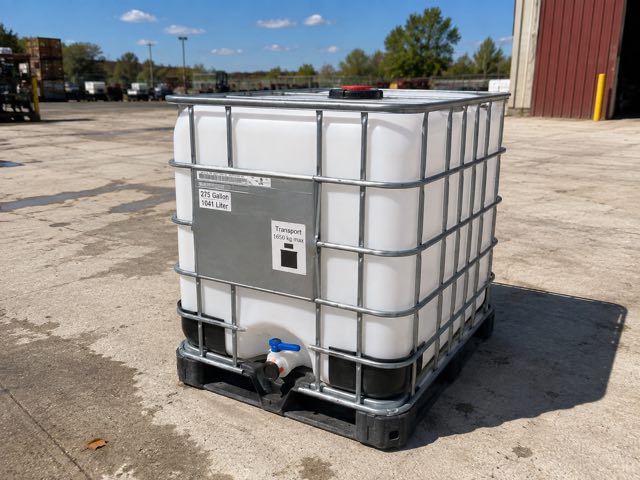
A standard IBC tote is 275 gallons on a 48 × 40 inch footprint, 46 inches tall, 125 lb empty and roughly 2,400 lb full of water. Everything else on this page is a variation on that number. If you only remember one specification, remember the footprint — it is what determines whether the container fits your rack, your truck and your doorway.
From the yard
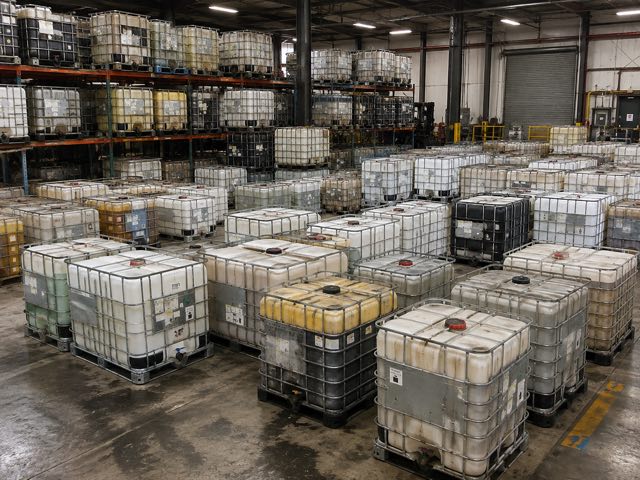
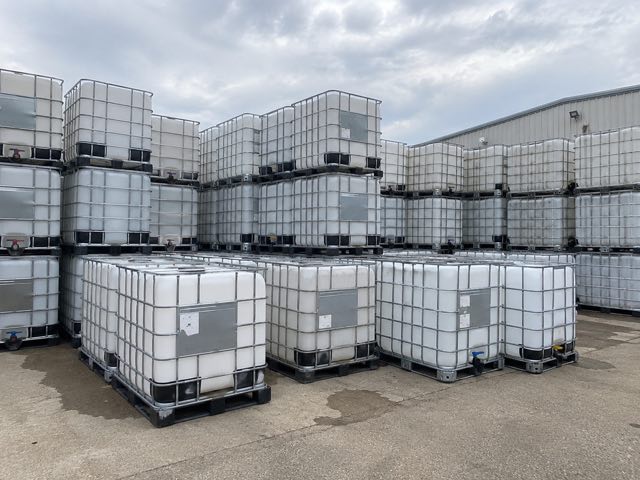
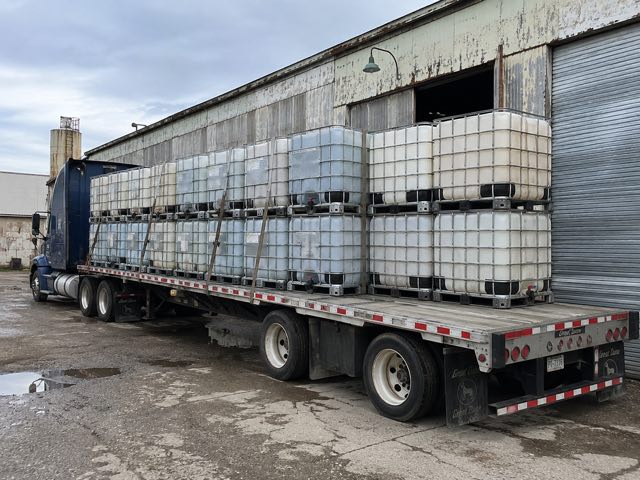
Every capacity we stock or source
Nominal figures for caged composite IBCs. Individual manufacturers vary by up to an inch and we confirm the exact unit before it ships.
| Capacity (gal) | Litres | Footprint (in) | Height (in) | Fill height (in) | Tare (lb) | Gross w/ water (lb) | Pallet |
|---|---|---|---|---|---|---|---|
| 120 | 454 | 40 × 32 | 38 | 30 | 78 | 1079 | Composite / plastic |
| 180 | 681 | 42 × 36 | 42 | 34 | 96 | 1597 | Composite |
| 275 | 1041 | 48 × 40 | 46 | 38 | 125 | 2418 | Composite / steel / plastic |
| 330 | 1249 | 48 × 40 | 53 | 45 | 145 | 2897 | Composite / steel |
| 350 | 1325 | 48 × 40 | 56 | 48 | 152 | 3071 | Steel |
| 550 | 2082 | 48 × 48 | 68 | 59 | 228 | 4815 | Steel |
| 793 | 3002 | 54 × 54 | 78 | 68 | 340 | 6954 | Steel, special order |
Metric quick reference
The measurement people forget
Freight class
Four dimensions that cause returned deliveries
Overall height with the pallet
46 inches for a 275, 53 for a 330. Measure your doorway, your rack beam spacing and your truck deck clearance against this figure, not against the bottle height.
Outlet centreline height
Roughly 6 inches off the ground on a standard 275. If you are gravity-feeding into a drum or a pump inlet, that six inches decides whether the system works.
Fork pocket spacing
Composite and steel pallets differ. Four-way entry is standard but pocket width varies; a narrow-carriage forklift can struggle with a steel pallet designed for wider tines.
Cage diagonal
62 inches corner to corner on a 48 × 40 unit. That is the number that matters for a tight turn in a corridor, not the 48.
How many containers do you actually need?
A working table for anyone sizing storage rather than buying a single tote.
| Volume needed (gal) | 275 gal units | 330 gal units | 550 gal units | Floor space (275s) | Notes |
|---|---|---|---|---|---|
| 550 | 2 | 2 | 1 | 27 sq ft | Two 275s beat one 550 if headroom is tight |
| 1,100 | 4 | 4 | 2 | 53 sq ft | Standard small-batch brewery holding |
| 2,200 | 8 | 7 | 4 | 107 sq ft | Manifold into a single draw point |
| 5,500 | 20 | 17 | 10 | 267 sq ft | Consider a bunded platform at this size |
| 11,000 | 40 | 34 | 20 | 533 sq ft | Double-stack static, three high maximum |
| 27,500 | 100 | 84 | 50 | 1,333 sq ft | Compare against a single fixed tank |
Six detailed size guides
Each one covers a single capacity or dimension question properly, with the specifications, the applications and the mistakes.
275 Gallon IBC Totes
The 1,041-litre workhorse: full specification, applications, pricing and the three things that go wrong.
Most common size
330 Gallon IBC Totes
Same footprint, seven more inches, 20% more volume — and the shelf-height problem that follows.
Best volume per sq ft
550 Gallon & Oversize
Bulk liquid on a single footprint, and the forklift capacity conversation that has to happen first.
Bulk storage
Dimensions & Weight Guide
Tare, gross, fill height, specific gravity, freight class and rack loading, worked through properly.
Engineering reference
Pallet & Footprint Guide
Composite, steel, plastic and wood bases: what each one costs you in weight, hygiene and durability.
Handling reference
Tote vs Drum vs Tank
Cost per gallon, floor space, handling and the crossover point where each option wins.
Comparison
Size chart FAQ
What size is a standard IBC tote?
The standard is 275 gallons (1,041 litres) on a 48 × 40 inch footprint, standing 46 inches tall including the cage and pallet. It weighs about 125 lb empty and around 2,400 lb gross with water. That single specification covers roughly three quarters of all IBC totes in circulation in North America, which is why pallet racking, truck decks and warehouse aisles are all sized around it.
What is the difference between a 275 and a 330 gallon tote?
Height, almost entirely. Both sit on the same 48 × 40 inch footprint; the 330 is 53 inches tall against 46. That extra seven inches is what catches people out — a 330 will not clear a 48-inch shelf, will not double-stack under an 8-foot ceiling with clearance, and adds roughly 500 lb to gross weight when full. If your floor space is fixed and your headroom is not, the 330 is free capacity. If your rack beams are set, it is a returned delivery.
How much does a full IBC tote weigh?
For water at 8.34 lb per gallon: a 275 gallon tote weighs about 2,418 lb gross, a 330 about 2,897 lb and a 550 about 4,815 lb. Denser liquids scale up quickly — the same 275 gallon tote holding a 1.4 specific gravity chemical grosses around 3,335 lb. Always check that your forklift, your rack beams and your floor loading can take the actual liquid, not the water figure.
Are all IBC totes the same footprint?
Nearly all composite caged IBCs from the major manufacturers are 48 × 40 inches, matching a standard GMA pallet, and they are interchangeable within about half an inch. The 550 gallon and some European units break this at 48 × 48. Smaller 120 and 180 gallon units use reduced footprints. If you are designing racking or bunding around them, work to 48 × 40 and check the specific unit before you weld anything.
How high can I stack IBC totes?
Two high in transit and three high static is the conservative industry practice for full composite IBCs, and it is what we recommend. Empty totes stack four high safely. The real constraints are the stacking load marked on the UN plate, whether the pallet types match — never stack mixed pallet types — and whether the bottom unit is full. A partially filled bottom container will deform under a full one.