Keeping regulated containers road-legal
Book inspection & un recertification
One written channel for everything: quotes, bookings, freight and questions. A person reads every one of these.
Under 49 CFR 178.813 a composite IBC used for regulated liquid must undergo a leak test at least every 2.5 years and a complete periodic inspection every 5 years. We perform both at the Bancroft Avenue yard for $38 per unit, including plate review, visual and structural inspection, a 3 psi leak test and a dated record retained for five years.
How it runs, step by step
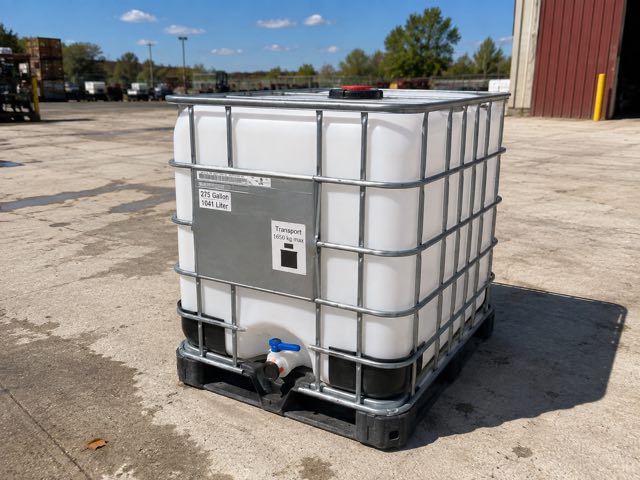
Plate and marking review
Design type, packing group, hydraulic test pressure, stacking load, manufacture date and last periodic test are read and photographed. An illegible plate cannot be certified — no exceptions, whatever the container’s condition.
Visual and structural inspection
Bottle checked for stress-crazing, deformation, discolouration and wall thinning. Cage checked for weld failure, base-ring corrosion and distortion. Pallet checked for rot, cracking and fastener integrity.
Leak test at 3 psi
Sealed, pressurised and monitored. Any decay outside tolerance fails the unit. Failures go to the rebuild bench once; a second failure ends the container’s regulated service life.
Record and mark
Result, date, inspector and unit number recorded, container marked accordingly. You receive the record with the container and a copy stays on file here for five years.
Before you book
Rated is not the same as suitable
We cannot create a rating
Test dates run from the plate
What we need from you
Five answers. Supply them with the first email and the job is quoted and scheduled without a single round trip.
Access to the plate
It must be legible. A plate painted over, corroded or scoured by a pressure washer held too close cannot be certified, and nothing restores it.
The current test history if you have it
Helpful, not essential — the marked dates on the container govern. But it tells us what to expect.
The liquid the container will carry
A rating certifies the design type; it says nothing about whether HDPE and your product get along. That check is separate and free.
A count and a location
Twenty or more inside the Bay Area and we bring the gauge to you, which saves two freight legs.
Whether you want a wash in the same visit
Combining is one freight leg instead of two and is almost always cheaper.
What is included
- Plate and marking review, photographed
- Visual and structural inspection of bottle, cage, base ring and pallet
- Leak test at 3 psi, held and monitored
- One return to the rebuild bench for a failed unit, then a re-test
- Result, date, inspector and unit number recorded and marked on the container
- Records retained for five years and reissued free at any time
What we will not do
- Creating a rating for a container that never carried one
- Transferring a plate between frames — we treat that as an automatic rejection
- Certifying a container that cannot hold 3 psi, whatever its condition otherwise
If it is not listed, ask
Turnaround, price and process
Indicative 2026 figures. Where a lane or a service level genuinely varies, the range is the range rather than the flattering end of it.
| Service | Price | Where | Turnaround | Interval |
|---|---|---|---|---|
| Leak test (2.5 year) | $38 per unit | At the yard | Same visit | Every 2.5 years |
| Full periodic inspection (5 year) | $38 per unit | At the yard | Same visit | Every 5 years |
| On-site inspection, 20+ units | $38 per unit + travel | Your site, Bay Area | Booked day | As required |
| Combined with a wash | $38 add-on | At the yard | Same visit | As required |
| Re-test after bench repair | Included once | At the yard | Same visit | — |
| Record reissue | Free | — | Same day | Any time within 5 years |
| Compatibility check | Free | — | Within a business day | Per liquid |
The problems this actually solves
"Our containers are sound but out of test"
"The auditor wants a test history we cannot find"
"A supplier offered to make our unrated containers rated"
What you end up holding
Reused containers live or die on documentation. This is everything that leaves here with the job, and how long we keep our copy.
| Document | Issued | We retain | What it is for |
|---|---|---|---|
| Periodic inspection record | Every inspected unit | 5 years | Regulatory compliance under 49 CFR 178.813 |
| Plate photographs | Every inspected unit | 5 years | Evidence of legibility at the time of test |
| Leak-test result | Every inspected unit | 5 years | Pass or fail, with the pressure decay noted |
| Failure report | Any failed unit | 5 years | Your decision on repair, rebottle or retire |
| Container marking | Every passed unit | On the unit | Visible evidence in the field |
Inspection & UN Recertification: FAQ
How often does an IBC need testing?
A leak test at least every 2.5 years and a full periodic inspection every 5 years, for composite IBCs in regulated liquid service under 49 CFR 178.813. Containers in non-regulated service — water, most agricultural inputs, non-hazardous industrial liquid — are not subject to this, though we still recommend a leak test on anything over five years old.
Can you inspect at my site?
For fleets of twenty or more within the Bay Area, yes — we bring the gauge and the paperwork to you, which avoids two freight legs. Below that it is cheaper to send the containers here, and we can combine the inspection with a wash in the same visit.
What if a container fails?
You get the failure mode, a photograph and a recommendation. Most failures are gasket or valve issues that we fix at the bench for a few dollars and re-test the same day. Genuine bottle failures end regulated service, and we will quote a rebottle or take the unit for credit.
Do you keep the records?
Yes, five years, tied to the unit number, and we will reissue a copy at any point at no charge. Several customers rely on us as their record of last resort when an auditor asks for a test history they cannot find.
How do I know when my containers are due?
Read the plate. The manufacture date is marked, and the periodic test dates are marked separately — those are the ones that expire. Composite IBCs in regulated liquid service need a leak test at least every 2.5 years and a full inspection every 5. If you bought the container second-hand, check before assuming you have time.
What if a container fails?
You get the failure mode, a photograph and a recommendation. Most failures are gasket or valve issues that we fix at the bench for a few dollars and re-test the same day, included. Genuine bottle failures end regulated service, and we will quote a rebottle or take the unit for credit rather than returning it and letting you find out later.
Is a rated container automatically suitable for our liquid?
No, and this is the most important thing on this page. A UN rating certifies the design type against drop, leakproofness, hydraulic pressure, stacking and vibration testing. Nothing in that involves your product. Send the safety data sheet and we check resin and gasket compatibility separately, free.