Two thousand litres on one footprint.
Price 550 gallon totes
Tell us your forklift capacity along with the quantity. If it will not lift a full one, we would rather sell you two 275s.
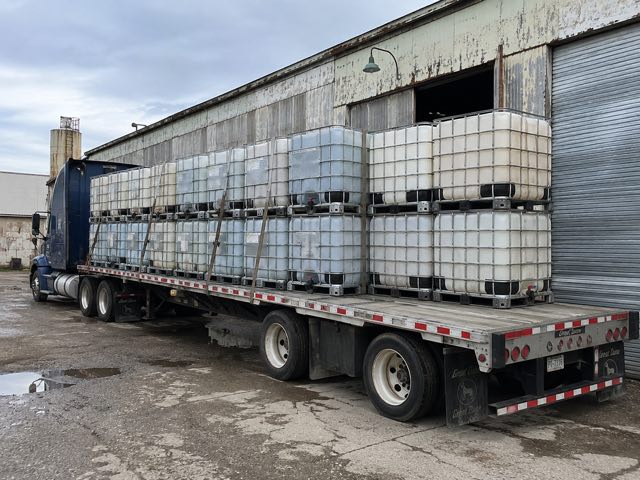
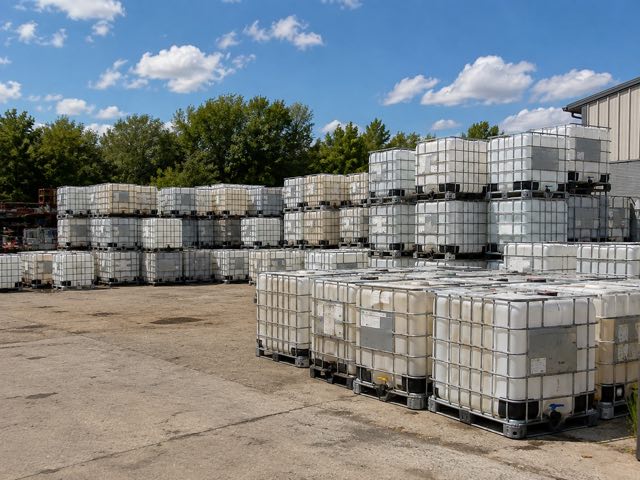
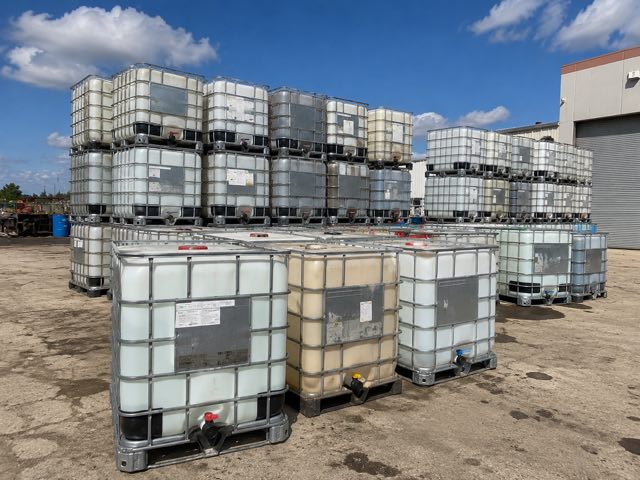
A 550 gallon IBC tote measures 48 × 48 × 68 inches, holds 2,082 litres, weighs 228 lb empty and 4,815 lb full of water. It halves the number of connections and handling movements for a given volume, and it costs about 13% less per gallon than a 275. It also will not fit standard racking, standard spill pallets or a 3,000 lb forklift — plan the handling before the purchase.
From the yard
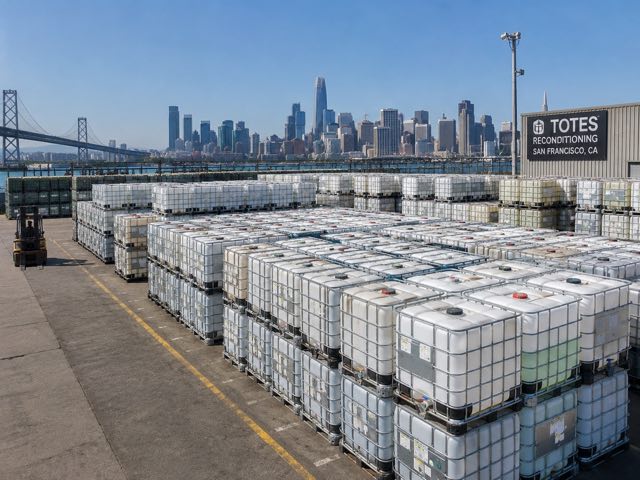
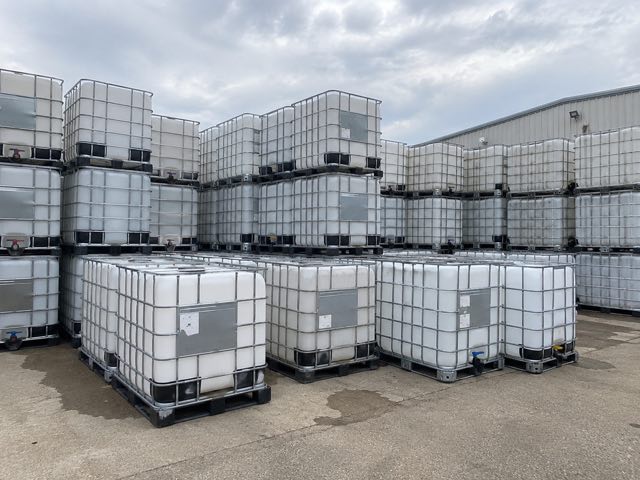
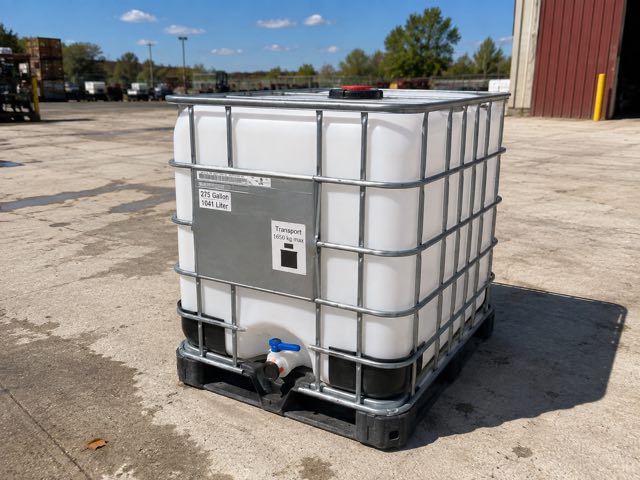
550 gallon in full
- Nominal capacity550 gal / 2,082 L
- Footprint48 × 48 in (1,219 × 1,219 mm)
- Overall height68 in (1,727 mm)
- Liquid fill height≈ 59 in
- Tare weight228 lb
- Gross with water4,815 lb
- Bottle materialHDPE, ≈ 96 lb
- Cage & palletSteel, ≈ 132 lb
- Outlet2 in or 3 in, S60×6 / camlock
- Stack ratingNot recommended stacked when full
- Minimum forklift6,000 lb rated
- Fits standard rackingNo — 48 × 48 base
Where the 550 pays off
| 275 gal | 330 gal | 550 gal | |
|---|---|---|---|
| Reconditioned price | $165 | $195 | $285 |
| Cost per gallon | $0.60 | $0.59 | $0.52 |
| Floor area | 13.3 sq ft | 13.3 sq ft | 16.0 sq ft |
| Gallons per sq ft | 20.7 | 24.8 | 34.4 |
| Units for 2,200 gal | 8 | 7 | 4 |
| Connections for 2,200 gal | 8 | 7 | 4 |
| Forklift needed (water) | 3,000 lb | 4,000 lb | 6,000 lb |
Four applications where the 550 is the obvious answer
Bulk edible oils
Importers and processors moving olive, canola and sunflower oil where a single delivery fills one container instead of two.
Winery must and juice
Harvest surge capacity in Napa and Sonoma, where forklifts are already sized for bins and the pad is outdoors.
Site and fire water
Construction and remote-site water storage where the container sits on grade and is filled by tanker.
Wastewater and effluent
Batch collection before treatment, where fewer, larger containers mean fewer transfers and fewer spill points.
Check the door, not just the room
Do not stack them full
Bunding needs custom work
550 gallon FAQ
Do I need a bigger forklift for a 550?
Almost certainly. A full 550 grosses 4,815 lb with water alone, which puts you in 6,000 lb forklift territory once you account for load-centre derating and any mast height. This is the single most common reason a 550 purchase goes wrong: the container is fine, the handling equipment is not, and the customer finds out on delivery day.
Why is the footprint 48 × 48 instead of 48 × 40?
Because the extra volume has to go somewhere and going purely upward would make the container unstable. The 48 × 48 base gives a lower centre of gravity for a 68-inch container. The practical consequence is that a 550 does not fit standard 48 × 40 pallet racking or standard spill pallets — you need equipment sized for it.
Is a 550 cheaper per gallon?
Yes, meaningfully: roughly $0.52 per gallon reconditioned against $0.60 for a 275. But the saving is easily erased by needing a larger forklift, custom bunding or a wider doorway. Do the total-cost arithmetic, not the container arithmetic.
What about even larger containers?
We can source 793 gallon steel-framed units on special order — 54 × 54 × 78 inches, 340 lb tare. Beyond that you are into fixed tanks, where the economics change completely and totes stop making sense. Our tote-versus-tank guide covers the crossover point.