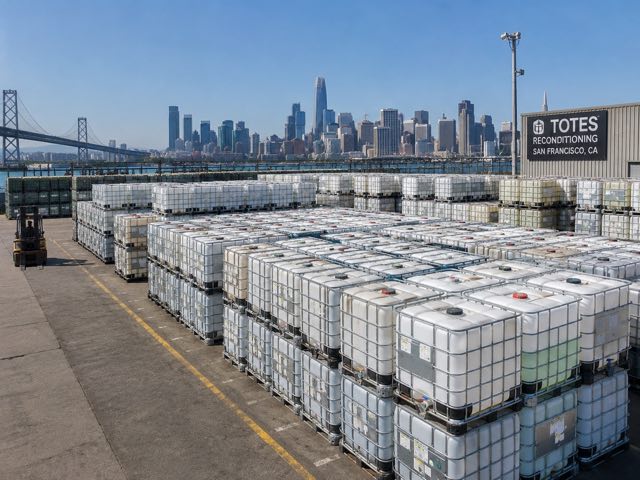
From 110 gallons per tote to seven.
Book a wash
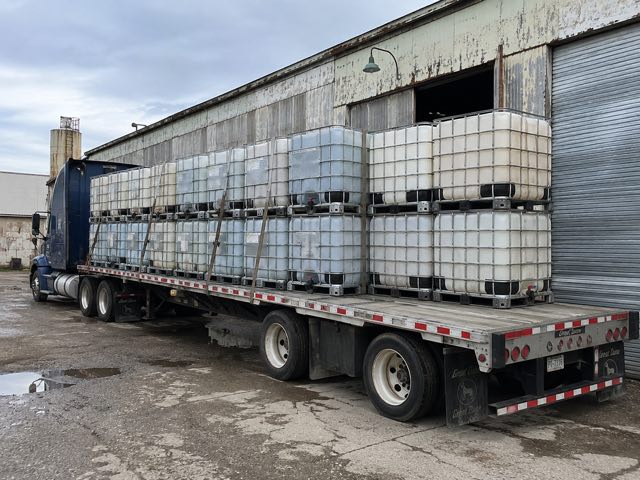
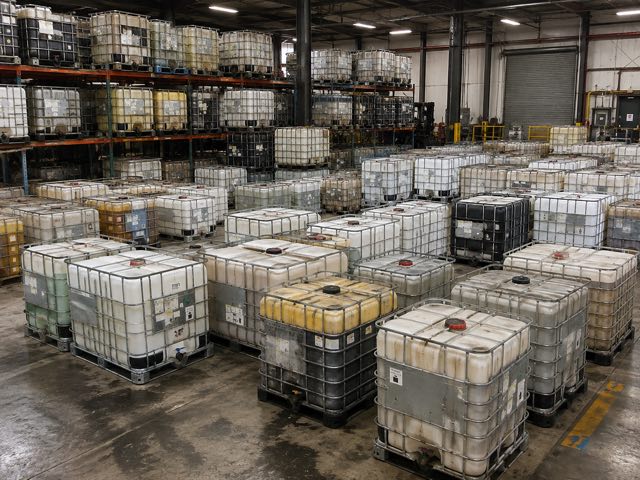
Toll washing on containers you already own. Send the prior contents and a count and we will confirm the wash route.
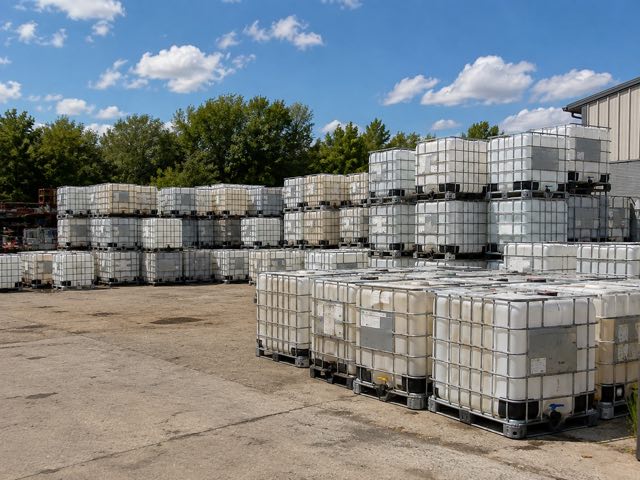
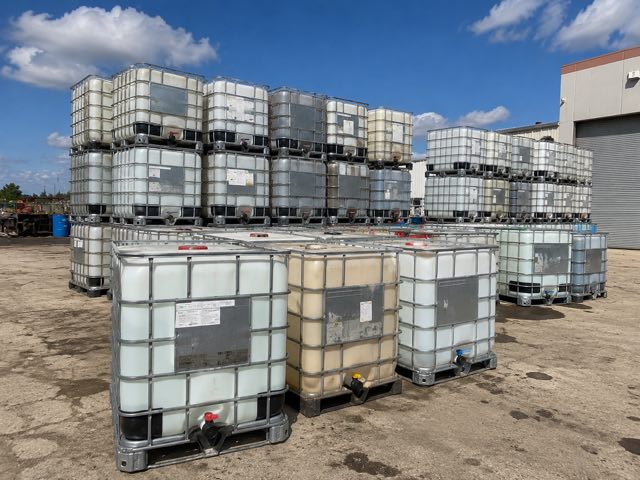
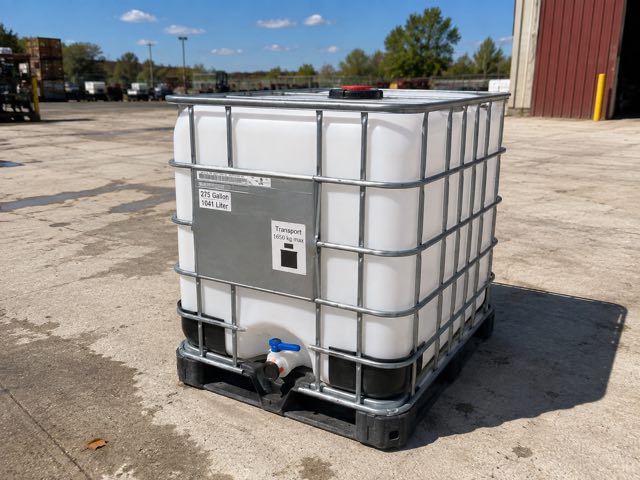
A closed-loop wash uses about seven gallons of fresh water per container. Pressure washing in a back lot uses around 110 — and discharges every drop of it, with product residue in suspension, into a storm drain. The difference is a separator that pulls solids and product out of the circuit so the water can go back around instead of away.
From the yard
How the water goes around
Caustic wash, 160 °F
Hot sodium hydroxide solution circulated through the container. Heat and alkalinity together saponify fats and lift cured residue that pressure alone smears around. Dwell time varies from four to eighteen minutes by prior product.
Stage one — gross solids
Spent solution drops into a settling chamber where labels, grit, sediment and anything that fell out of a cage separate by gravity. Skimmed daily.
Stage two — oil and fat separation
A coalescing plate pack pulls saponified fats and free oil to the surface for skimming. This is the stage that makes olive-oil and lubricant containers economic to wash at all.
Stage three — fines and polish
A bag filter train removes suspended fines down to 25 microns before the solution is returned to the heated caustic tank.
Conductivity check and purge
Circuit conductivity is checked each shift. When dissolved load climbs past the set point we purge a measured volume rather than degrading wash quality — this purge is most of the 6% that does not get recovered.
Rinse stages on fresh water
The three rinse stages use fresh water, cascaded backwards: the final rinse is clean, and its runoff becomes the second rinse, whose runoff becomes the first. That cascade is where most of the fresh-water saving actually comes from.
Heat recovery
Spent rinse water passes through a plate heat exchanger on its way out, pre-heating incoming fresh water. Worth roughly 9% off the gas bill and it cost less than a used flatbed.
Sludge dewatering and manifest
Skimmings and filter cake are dewatered and drummed for collection by a permitted treatment facility. Weighed, logged, manifested. Roughly 340 lb a week.
What changed in 2012
The honest version
| Pressure wash + drain | Closed loop | Change | |
|---|---|---|---|
| Fresh water per container | 110 gal | 7 gal | −94% |
| Discharge to sewer | 110 gal | 0 gal | −100% |
| Residue captured | None | 340 lb/week | manifested |
| Fats and oils removed | Poorly | Coalescing plate pack | reliable |
| Gas for heating | Baseline | −9% via heat exchange | lower |
| Documentation possible | No | Wash certificate | auditable |
| Capital cost | $1,400 | $118,000 | paid back in ~5 yr |
Wash-loop FAQ
What does 94% recovery actually mean?
Of the water entering the wash circuit in a given week, 94% is recovered by the separator and re-used rather than discharged. The remaining 6% leaves as moisture in the sludge cake, as evaporation from the hot bays, and as the small purge we take when conductivity climbs. Fresh make-up water works out at roughly seven gallons per container washed.
Where does the sludge go?
To a permitted treatment facility under manifest. It is the concentrated product residue, solids and saponified fats that the separator pulls out of the circuit — roughly 340 lb a week, dewatered. Nothing enters the sewer and nothing enters the storm system.
Could a smaller operation do this?
The three-stage separator cost $118,000 installed in 2012 and paid back in about five years on water and sewer charges alone. Below roughly 200 containers a week the arithmetic does not work, which is honestly why most small operators pressure wash and discharge. That is the practice we would most like to see regulated out of existence.