The greenest container is the one nobody had to build.
Request our impact methodology
Sustainability teams, auditors and procurement: ask for the full spreadsheet and we will send the workings, not a brochure.
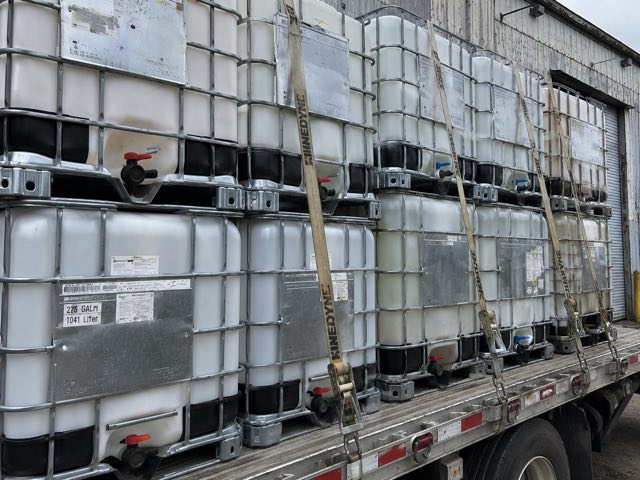
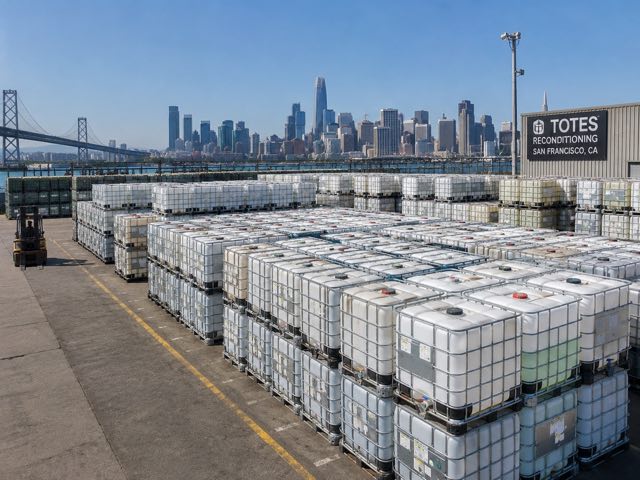
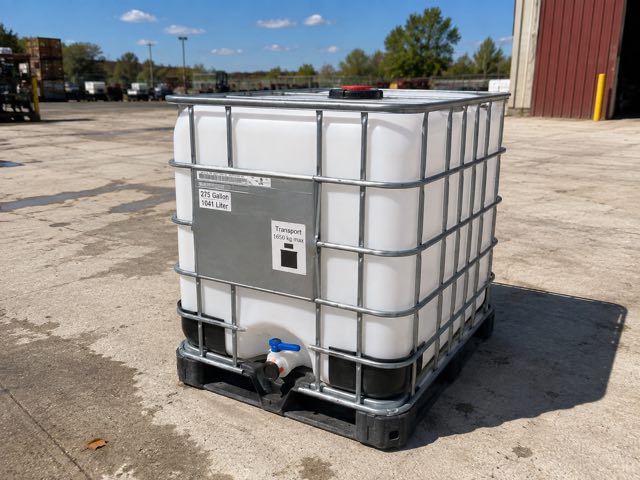
Reusing one 275 gallon IBC tote avoids roughly 235 lb of virgin HDPE and galvanised steel, about 250 lb of CO₂e, 490 gallons of process water and 1.9 cubic yards of landfill volume — per cycle. Multiply by our yard average of six cycles and a single container carries more than 1,400 lb of avoided material over its working life. That is the entire argument for this company in one sentence.
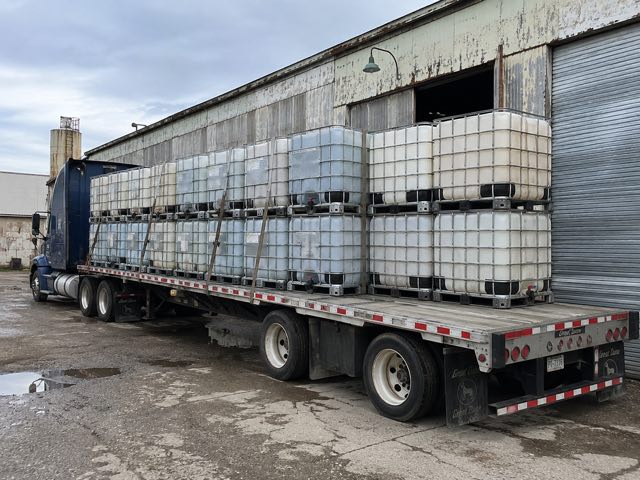
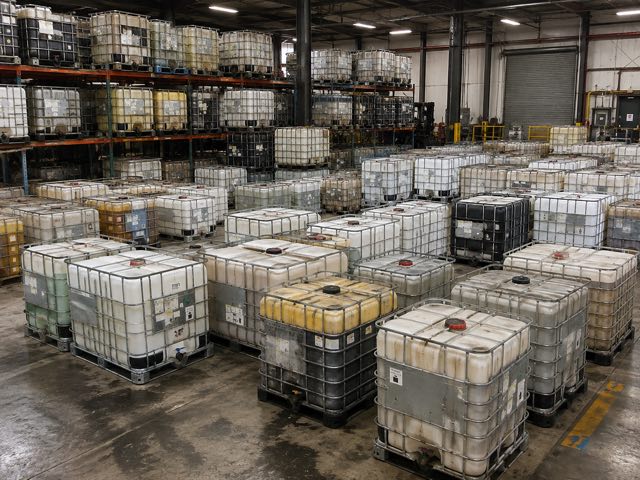
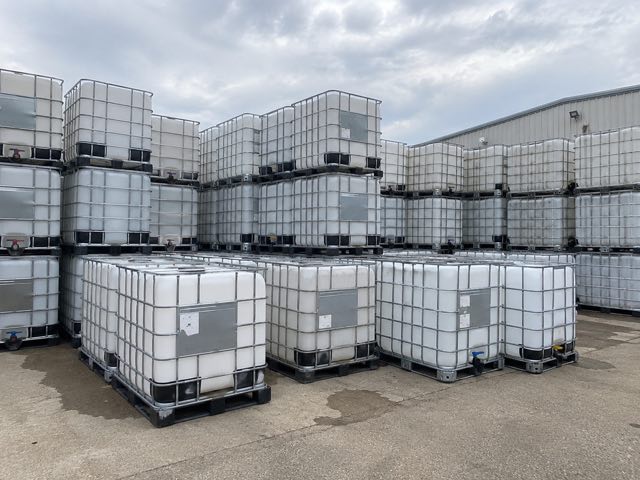
From the yard
Where the mass goes
Reconciled quarterly against scale tickets and disposal manifests.
| Destination | Share of inbound mass | What it becomes | Verified by |
|---|---|---|---|
| Resold as reconditioned | 54.2% | Back into liquid service, same bottle | Sales manifest + unit number |
| Rebottled and resold | 21.8% | Reused cage and pallet, new bottle | Sales manifest + unit number |
| Cage & parts recovery | 11.4% | Straightened cages, valve and gasket stock | Internal parts ledger |
| HDPE granulation | 9.6% | Regrind for pipe, chocks, pallets | Outbound scale ticket |
| Steel to scrap processor | 1.6% | Remelted structural steel | Processor weigh receipt |
| Landfill | 1.4% | Contaminated composite trim, bonded rubber | Disposal manifest |
Model your own avoided impact
This is the same engine we use to build customer diversion statements. Change the size, the sourcing route and the cycle count and watch the arithmetic move.
96 containers kept out of production
That is roughly 27,594 miles of driving avoided, or the annual carbon uptake of 494 mature trees.
Figures are directional, not an audited LCA. They combine our weighed container masses with published cradle-to-gate factors for virgin HDPE and galvanised steel. We will happily show you the spreadsheet.
The other things we changed
94% recovered, not discharged
A three-stage separator pulls solids and residual product out of the caustic circuit so the water goes back around. A wash that used to take 110 gallons of fresh water now takes about 7. Sludge is manifested to a permitted treatment facility rather than dosed into the sewer.
62 kW on the roof
Installed 2022, covering roughly 41% of yard load including the granulator and the hot-water plant. The wash bays run on a heat exchanger that recovers energy from spent rinse water before it re-enters the circuit — worth another 9% off the gas bill.
Backhauls, not empty miles
Every delivery run is planned as a collection run in reverse. Roughly 71% of our outbound flatbed miles come back loaded with empties, which is the single cheapest carbon reduction available to a business like ours.
Four things we will not claim
We are not carbon neutral
Reuse has a ceiling
HDPE stress-crazes. After roughly six to eight cycles a bottle is genuinely at end of life and pretending otherwise puts someone's liquid on the floor. We granulate it and say so.
Recycled content is not free
Our regrind goes into pipe and pallets, not into new IBC bottles. Food-contact and pressure applications require virgin resin, and no amount of enthusiasm changes that.
Some totes should not be reused
Anything that held a persistent pesticide, a strong solvent that swelled the wall, or an unidentified product goes straight to granulation. Roughly 6% of offered stock is refused for this reason and we would rather lose the margin.
A percentage without a denominator is marketing
Our diversion figure is calculated on total inbound mass, including the material we refuse. It would be trivially easy to make the number look better by excluding what we turn away.
Sustainability FAQ
Is reusing an IBC tote really better than recycling one?
Substantially, and it is not close. Recycling a 275 gallon tote recovers the material but still spends energy shredding, washing, melting and re-moulding it, and the resulting regrind is downcycled into lower-value products. Reusing the same container avoids about 235 lb of virgin material and roughly 250 lb of CO₂e per turn while spending only the energy of a wash cycle — around 4 kWh and 38 gallons of water, 94% of which we recover. That is why our whole operation is designed to delay recycling rather than accelerate it.
How do you calculate the numbers you publish?
Container masses come from our own certified truck scale, split into HDPE and steel by component. Impact factors come from published cradle-to-gate life-cycle figures for virgin HDPE resin and virgin galvanised steel. Diversion is calculated as inbound mass minus landfilled mass, divided by inbound mass, reconciled quarterly against disposal manifests. We do not count avoided impact from containers we merely handled — only from containers that actually went back into service or into our granulator.
Can I get diversion figures for my own reporting?
Yes. Every account gets a running statement showing containers purchased, containers returned, mass diverted and estimated avoided CO₂e, issued quarterly or on demand. Several of our customers put those figures straight into CDP disclosures and municipal sustainability reports. Ask the quote desk to switch reporting on when you open the account — there is no charge.
What happens to the 1.4% you do not divert?
It is mostly composite pallet trim contaminated with cured resin, gasket rubber bonded to metal, and the small share of bottles whose prior contents make granulation unsafe. Those go to a permitted disposal facility with a manifest. We publish the tonnage rather than hiding it, because a diversion figure with no denominator is marketing, not measurement.
Does buying used mean accepting worse quality?
No, it means accepting honest grading. A Grade A washed tote will hold your liquid exactly as well as a new one; what you give up is cosmetic uniformity — scuffs on the cage, label residue, a bottle that is not showroom-clear. If your process genuinely needs virgin resin, we sell new containers too and will tell you when that is the right call. What we will not do is sell you a B and call it an A.