Reconditioned IBC totes, washed and honestly graded
Price reconditioned ibc totes
Quantity, liquid and zip code is enough to get a real number back. We confirm grade and stock before we quote — no auto-replies.
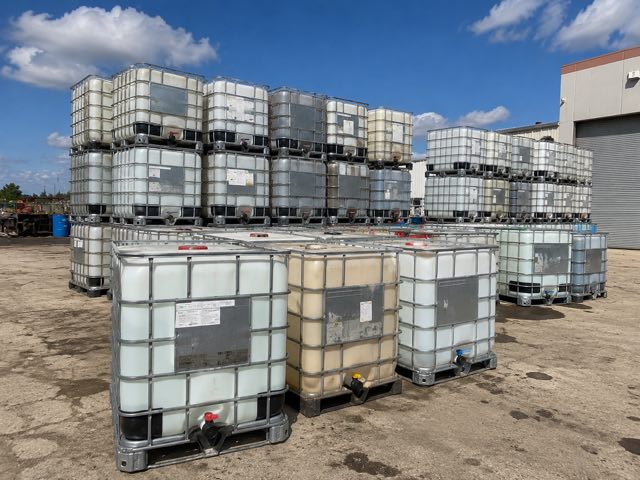
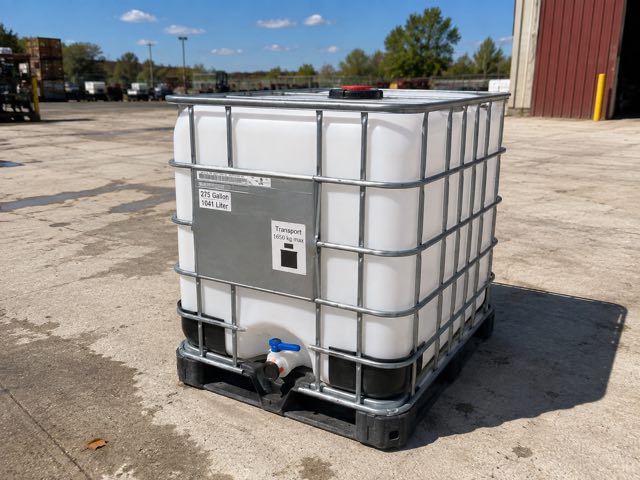
A reconditioned IBC tote is an original container that has been emptied, triple-rinse washed, inspected, re-gasketed and leak-tested rather than remanufactured. It costs roughly 55% less than new, performs identically for non-hazardous liquid service, and avoids about 235 lb of virgin material per unit. It is the right answer for most industrial, agricultural and construction water applications.
The numbers on the plate
Everything below is what you actually receive. Where a figure varies by manufacturer we quote the range rather than the flattering end of it, and we confirm the exact unit before it ships.
- Capacities in stock275, 330, 550 gal
- BottleOriginal HDPE, washed
- CageGalvanised steel, straightened
- PalletComposite, steel or poly
- Outlet2 in butterfly valve, new EPDM gasket
- Lid6 in vented or solid, replaced as needed
- Leak test3 psi held and monitored
- DocumentationPrior contents + grade record
- Typical lead time1–3 business days
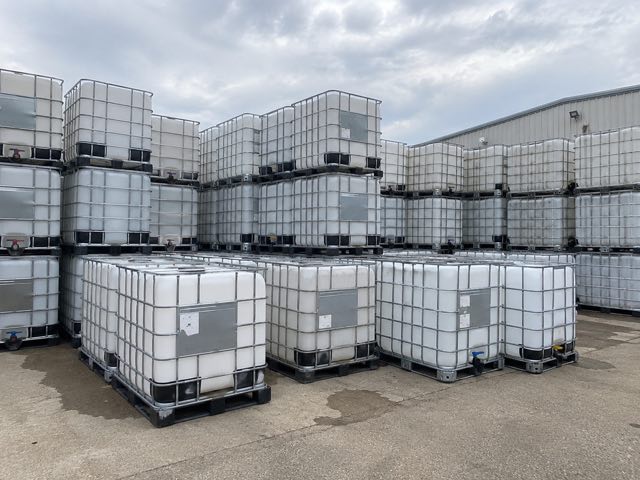
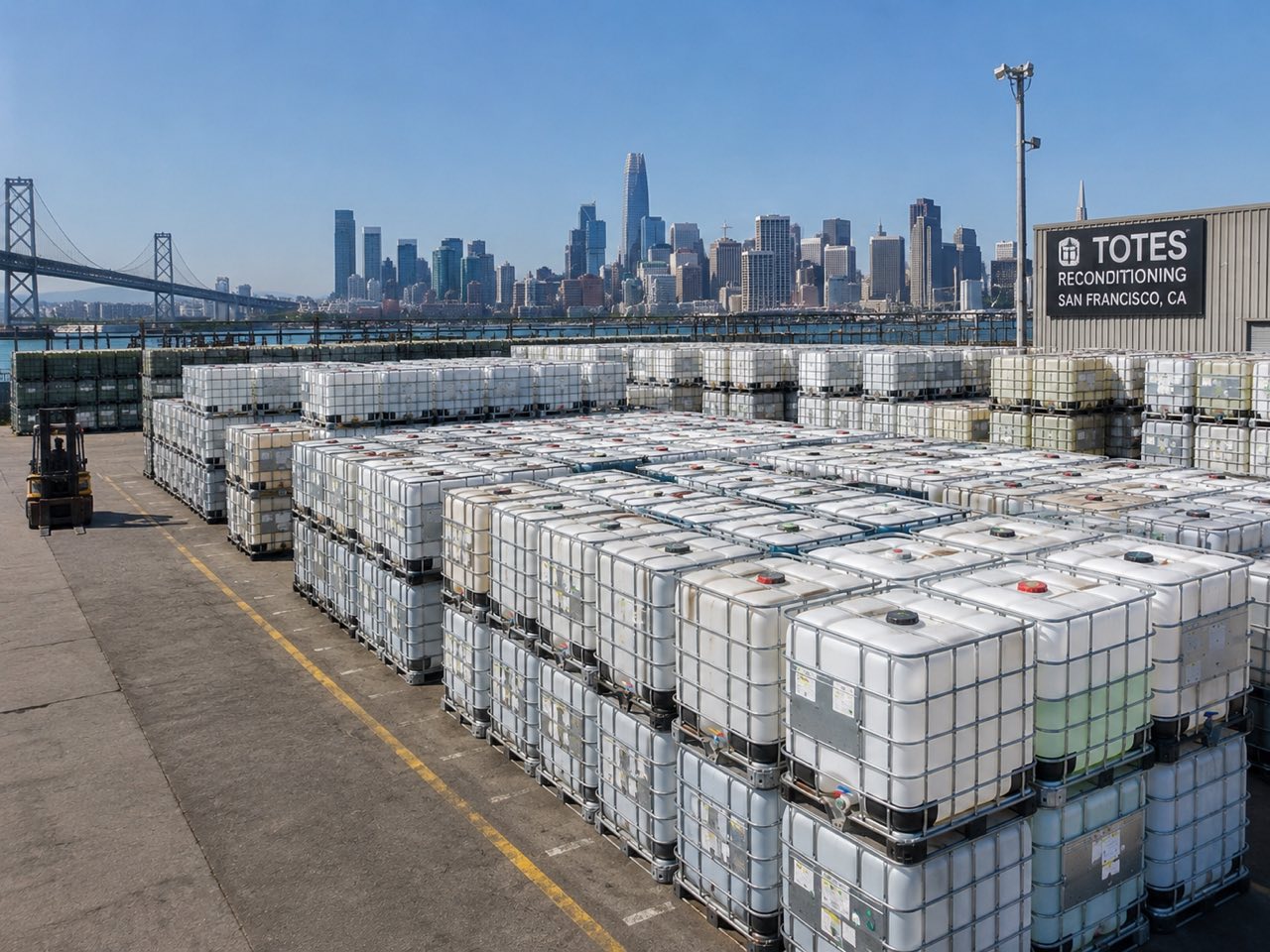
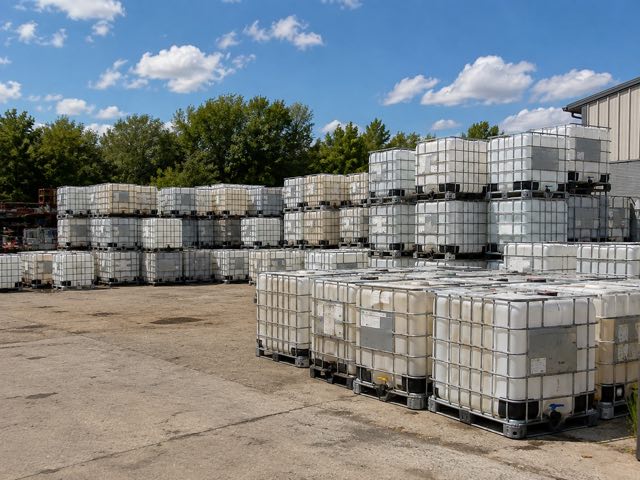
- Stock on hand600–900 units
Grades and what they actually mean
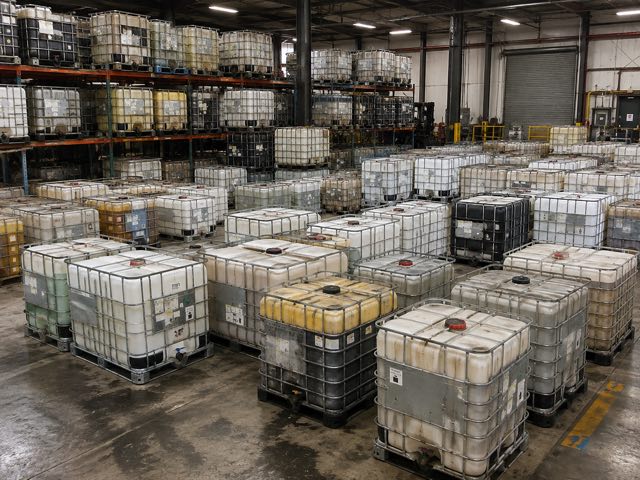
We photograph and record a grade against a unit number. It does not move because a pallet ran out.
| Grade | Interior | Cage & pallet | Prior contents | Typical price (275 gal) | Best for |
|---|---|---|---|---|---|
| A — food-safe | Washed on the dedicated food line, no residue, no odour | Straight, clean, no weld repair | Single food-contact product, traceable | $165 – $235 | Beverage, produce, cosmetics, potable water |
| A — washed industrial | Triple-rinse washed, clear of residue, faint odour possible | Straight, cosmetic scuffing only | Named non-hazardous industrial product | $145 – $195 | Chemical blending, ag inputs, wash water |
| B — rinsed | Rinsed not washed, visible staining, residual odour | Minor dents, possible weld repair | Named, non-hazardous | $115 – $155 | Construction water, dust control, ballast |
| C — as-is | Not cleaned; sold explicitly as-is | Cosmetic damage acceptable, functional | Named, non-hazardous | $85 – $120 | Rain capture with a liner, storage, upcycling |
Where they end up
Chemical blending and transfer
Compatible with most water-based industrial chemistry. Send us the safety data sheet and we will check HDPE compatibility and gasket material before quoting — swelling agents and strong solvents get refused, not sold.
Agricultural inputs
Liquid fertiliser, fish emulsion, compost tea and irrigation dosing. Vineyard and orchard customers between Napa and Salinas are our single largest seasonal segment.
Construction and dust control
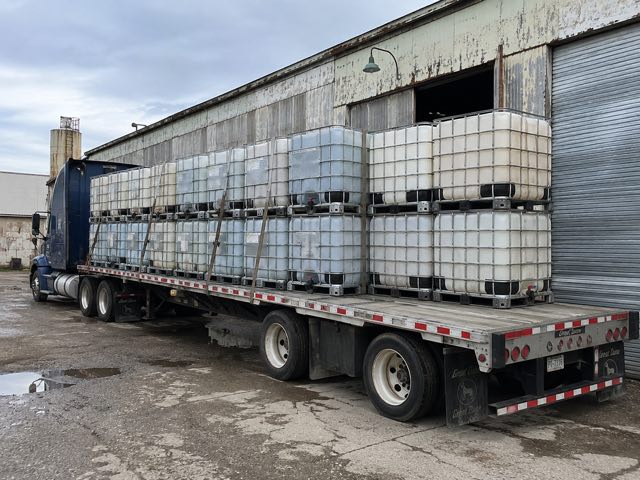
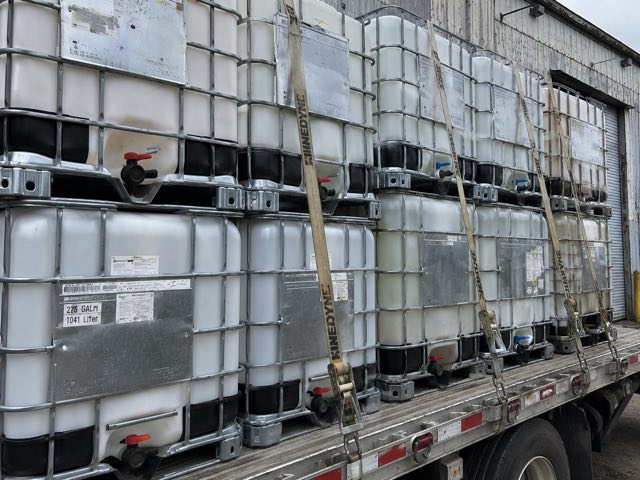
Grade B and C units on skid frames for site water, dust suppression and concrete washout. Cheap, replaceable and delivered on a flatbed the same week.
Wastewater and treatment dosing
Municipal and industrial dosing stations, often with a bunded secondary containment pallet from our accessories range.
What we do to it first
Graded before it is washed
Nothing goes into a bay until it has a unit number, a prior-contents record and a photographed grade. This is why our A stock is genuinely A.
Triple rinse and caustic circuit
Hot caustic at 160°F, three rinse stages, potable final flush on the food line. 94% of the water is recovered and re-used.
Gaskets, valve and lid
Every outlet gets a new EPDM gasket. Valves and lids are replaced rather than cleaned when there is any doubt.
Cage, pallet, leak test
Cage straightened in a jig, pallet swapped if it is soft or split, then sealed and held at 3 psi. Failures go back to the bench once.
What it will and will not hold
HDPE is the bottle in every case; what changes with your liquid is the gasket, the dwell you should expect from a wash, and occasionally whether we will sell you the container at all. Send the safety data sheet and this becomes a fifteen-minute check rather than a judgement call.
| Contents | Verdict | Gasket | What decides it |
|---|---|---|---|
| Water, brine, potable-adjacent | Yes | EPDM (standard) | Grade A only for anything that will be drunk; sanitise before first fill |
| Dilute acids (under 30%) | Yes | EPDM (standard) | Check concentration — the gasket, not the bottle, sets the limit |
| Caustic soda up to 50% | Yes | EPDM (standard) | Grosses 3,633 lb at 275 gal; check the forklift before the container |
| Liquid fertiliser, UAN, ag inputs | Yes | EPDM (standard) | The single largest use of Grade B stock in our book |
| Vegetable and mineral oils | Yes | Nitrile | EPDM is the wrong gasket here and fails within weeks |
| Diesel, kerosene, light fuels | Yes, with containment | Nitrile | SPCC and local fire code generally require a bunded pallet |
| Aromatic and chlorinated solvents | No | — | Swells and softens the wall; we will decline the sale |
| Strong oxidisers at concentration | No | — | Degrades HDPE; use a container specified for it |
| Limonene and terpene cleaners | Usually no | Viton (FKM) | Surprises people — it attacks HDPE more than the label suggests |
Exactly what you receive
- The container, graded and photographed against a unit number
- A new food-contact grade EPDM outlet gasket, fitted
- A 2 in butterfly outlet valve — new, or verified and function-tested
- A 6 in lid, vented or solid, to your specification
- A written prior-contents record naming the previous product
- The grade record with the photographs taken at intake
- A leak-test record showing the unit held 3 psi
What you will need separately
- A UV-opaque cover ($48) — essential for anything stored outdoors
- Camlock or garden-hose adapters ($9–$22) — the outlet is S60×6 buttress
- Secondary containment — quoted separately, and required for oils and fuels
- Sanitisation — a wash certificate is not a sanitisation certificate
Ask before you order, not after
Five checks worth five minutes
Written from the problems that reach our returns desk, which is the only honest source for a list like this.
Read the plate before you plan the fill
Capacity, maximum gross mass and, where present, the UN design type and periodic test dates. The clock on those dates runs from manufacture, not from when you bought it.
Calculate the real gross weight
Tare + (gallons × 8.34 × specific gravity). Not the water figure. Then check it against your forklift at the load centre you will actually use, not the number on the badge.
Rake a torch across the lower corners
Ten seconds a corner, at a shallow angle. A fine white network is stress-crazing. We grade for it, but a container that has travelled deserves a second look.
Fit a vented lid if you will draw down
Drawing liquid from a sealed container pulls a vacuum and permanently dents the bottle. Sixteen dollars, and it is the most common self-inflicted damage we see.
Confirm the gasket matches the liquid
We fit EPDM as standard because it suits most water-based chemistry. Oils and fuels need nitrile. Tell us and we fit the right one before it ships.
Three mistakes we watch people make
Buying Grade A for a Grade B job
Assuming 2,400 lb
Storing outdoors uncovered
The commercial detail
Indicative 2026 yard pricing. Everything is quoted properly before anything moves, and freight is always itemised separately.
| Grade | 1–11 units | 12–47 units | 48+ units | Lead time | Documentation |
|---|---|---|---|---|---|
| A — food-safe | $165 – $235 | −10% | −16% | 1–3 days | Prior contents + food-line wash certificate |
| A — washed industrial | $145 – $195 | −10% | −16% | 1–3 days | Prior contents + wash certificate |
| B — rinsed | $115 – $155 | −10% | −16% | 1–3 days | Prior contents + grade record |
| C — as-is | $85 – $120 | −8% | −14% | Same week | Prior contents + grade record |
| Toll wash of your own units | $38 – $72 | same | same | 3–7 days | Wash certificate per unit number |
Reconditioned IBC Totes: FAQ
How do I know what was in it before?
Every reconditioned unit ships with a prior-contents record naming the product and, where we have it, the shipper. We refuse roughly 6% of offered stock precisely because we cannot establish that history. If a supplier will not tell you what was in a used tote, that is not a discount — that is a liability.
Will a reconditioned tote leak?
Every unit is sealed and held at 3 psi before it ships, and the failure rate on delivered units is under 0.4%. Most field leaks we hear about trace to the outlet gasket or an over-torqued valve, which is exactly why we replace the gasket on every container rather than reusing it.
Can I get a reconditioned tote for drinking water?
Only a Grade A food-safe unit with a documented food-contact history, and even then you should sanitise before potable use. For long-term potable storage most customers are better served by a rebottled unit or a new one — we would rather point you there than sell you something you will worry about.
What sizes do you keep on the ground?
275 gallon is the bulk of it — usually 500 to 700 units. 330 gallon runs 80 to 150 units and 550 gallon is typically 20 to 40. If you need a large matched lot of one size, give us a week and we will build it out of inbound stock rather than sending you a mixed pallet.
How many service cycles does a reconditioned container have left?
Our yard average is six full cycles across a bottle's life, and a Grade A washed unit has typically used one to three of them. So three to five remaining is a fair expectation, which for most customers is eight to fifteen years. Stored outdoors uncovered, halve it. The honest limit is stress-crazing, and we grade for it at every wash.
Can I stack these two high with liquid in them?
Two high in transit and three high static is the conservative practice for full composite IBCs, on matched pallet types only, with the fuller container underneath. Where the UN plate states a stacking load, that figure governs. Never stack mixed pallet types — the load path through a composite base and a steel base is completely different.
What if I need forty identical units?
Say so and give us about a week. Matched lots are built out of inbound stock rather than pulled off the yard floor: same manufacturer, same valve, same pallet type, so your handling equipment and your fittings behave the same across the fleet. It costs nothing extra, it just needs time.