The eight checks
Calculate the real gross weight
Tare + (gallons × 8.34 × specific gravity). Not the water figure. A 275 gallon tote of 50% caustic is 3,633 lb, which is outside the safe envelope of a great many forklifts in daily use.
Derate the forklift
Capacity plates assume a 24-inch load centre. A tote is a 48-inch-deep load, so your effective capacity is lower — often 20–30% lower — and lower again at mast height. Check the truck’s own derating chart, not the headline number.
Never exceed two high full, three static
And never stack mismatched pallet types or a full container on a partially filled one. The lower bottle deforms and the load path goes somewhere it was not designed to go.
Vent before you draw
Drawing liquid from a sealed tote pulls a vacuum that permanently deforms the bottle. A vented lid costs $16 and prevents a dent that permanently reduces usable volume — and, in the worst case, a collapse that splits a seam.
Fit secondary containment where it is required
Oils, fuels and regulated chemistry generally need a sump sized to the largest container plus freeboard, under SPCC rules and most local fire codes. A two-tote poly pallet with a 66 gallon sump covers a single 275.
Bond and ground for flammables
Composite IBCs are not conductive. Transferring flammable liquid into or out of a plastic container generates static, and static plus flammable vapour is how tanks ignite. Use a conductive or antistatic container, or bond and ground the whole transfer system.
Check compatibility before you fill, not after
HDPE handles most water-based chemistry but is attacked by strong oxidisers and swelled by many solvents. Gasket material matters as much as the bottle — EPDM, nitrile and Viton behave very differently. Send us the safety data sheet.
Inspect at every fill
Sixty seconds with a light: crazing at the shoulders and lower corners, base bulge, cage weld integrity, base-ring corrosion, pallet softness, valve weep, gasket condition. This is the check that catches problems before they become spills.
How IBCs actually fail
| Failure | Root cause | Warning sign | Prevention |
|---|---|---|---|
| Outlet weep | Reused or over-torqued gasket | Damp ring under the valve | New EPDM gasket, torque to spec |
| Bottle collapse | Drawing from a sealed container | Inward dent at the top panels | Vented lid |
| Corner split | Stress-crazing after many cycles | White crazing network at the shoulder | Inspect at fill, retire at grade |
| Base bulge and rupture | Prolonged storage of a dense liquid | Base sitting proud of the pallet | Check SG against the plate’s gross mass |
| Cage collapse in a stack | Overstacking or mismatched pallets | Distorted top rail | Two high full, matched pallets only |
| Pallet failure | Rot, deck cracking, corroded runners | Soft spots, visible cracks | Swap the pallet at first sign |
Moving containers safely
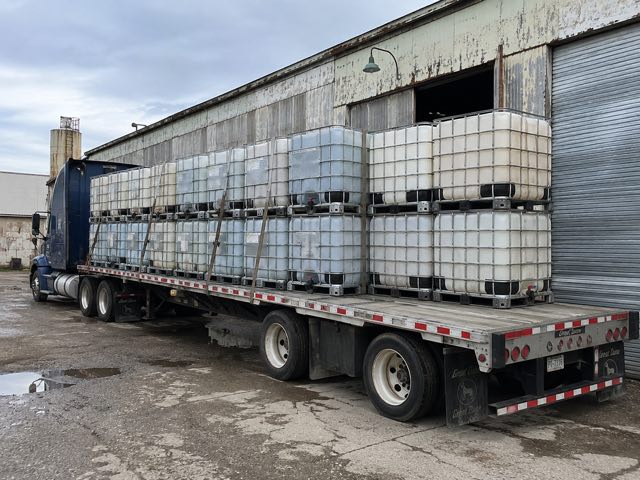
- Strap over the cage top rail, never over the bottle. A ratchet strap tensioned across a filled bottle deforms it.
- Never move a partially filled tote quickly. Liquid slosh in a half-full container generates dynamic loads that a full one does not, and it will move a forklift.
- Confirm the receiving site has a forklift or book liftgate service. This is the most common avoidable delivery failure by a wide margin.
- Placard correctly for regulated liquid, and confirm the periodic test dates on the plate are current before the container moves.
- Check the turning diagonal, not the footprint: a 48 × 40 unit is 62 inches corner to corner and that is the number that matters in a corridor.
Frequently asked
How high can I safely stack IBC totes?
Two high in transit and three high static for full composite IBCs, and only on matched pallet types with the fuller container underneath. Empty totes stack four high. The stacking load marked on the UN plate is the governing figure where one exists — treat these general rules as the ceiling, not the target.
Do I need a spill pallet?
For oils, fuels and regulated chemistry, usually yes. SPCC rules and most local fire codes require secondary containment sized to hold the largest container plus freeboard. For water, most agricultural inputs and non-hazardous industrial liquid it is good practice rather than a requirement — and cheap insurance against a floor you have to remediate.
Why did my tote collapse inward?
You drew liquid out of a sealed container and pulled a vacuum. HDPE has almost no resistance to negative pressure. Fit a vented lid, and if the deformation is mild you can sometimes recover the shape by capping and pressurising very gently — though the container should be regarded as degraded either way.
Can I store flammable liquids in an IBC?
Only in a container rated and marked for it, with proper bonding and grounding, in compliance with your local fire code — and often only in a fire-rated cabinet or dedicated store. Composite IBCs are not conductive and static during transfer is a genuine ignition risk. This is one where you should talk to your fire marshal before you talk to us.
Written by the yard team at IBC Totes San Francisco. Last reviewed February 2026. Spotted something wrong? Tell us — we would rather fix it than defend it.