The short version
- Leave 10% headspace — the expansion has to go somewhere.
- Valves and exposed lines freeze long before the bulk liquid does.
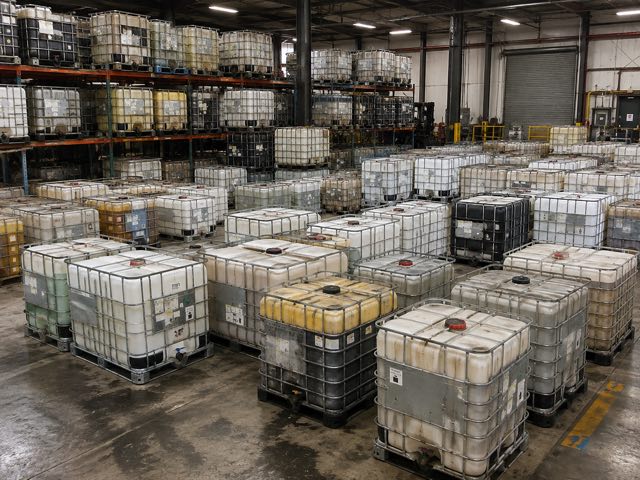
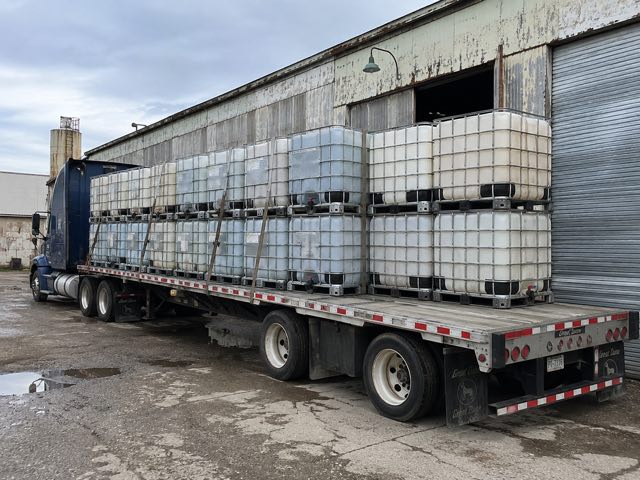
- An empty 275 gallon tote is 125 lb with a big sail area; wind moves them.
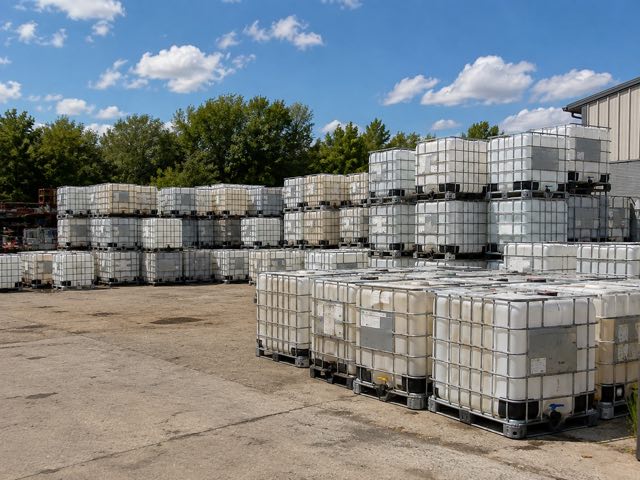
- Keep containers off a roof drip line — constant dripping corrodes base rings faster than rain.
It depends enormously on where you are
In San Francisco proper, freeze damage is close to a non-issue. We are moderated by the bay and the fog, and a hard freeze at the yard is a once-in-several-years event. Customers here can largely skip this article.
Twenty miles inland the picture changes fast. Livermore, Fairfield, Sacramento, Stockton and anywhere in the foothills see genuine sub-freezing nights most winters. We buy back damaged containers from those areas every January, and it is almost always the same three failures.
The three ways winter kills a container
| Failure | Cause | What you see | Prevention |
|---|---|---|---|
| Panel bowing | Full container, water expands 9% | Bowed lower panels, permanent | 10% headspace |
| Valve split | Water in the outlet throat freezes first | Cracked body, weeps on thaw | Drain the valve and lines |
| Base cracking | Ground heaves, container sits unevenly | Crack at a pallet corner | Compacted gravel, level base |
The valve one is the most common by a distance and the easiest to prevent. The outlet throat holds a small volume of liquid with a large surface area exposed to cold air. It freezes hours before the bulk liquid does, and a poly butterfly body does not survive it.
The November checklist
Leave headspace in anything that might freeze
Ten per cent is the rule. If a container must stay full through a freeze, it needs an insulated jacket or a thermostatic heater blanket, not optimism.
Drain taps, valves and exposed lines
Open the outlet, let the throat clear, and disconnect any hose that will not be used. This is a five-minute job per container and prevents most winter damage we see.
Fit or check UV-opaque covers
Winter sun is weaker but the covers also shed rain away from the cage top and keep the base ring drier. Leave them on year-round.
Check the ground
Containers on soil will settle unevenly over a wet winter. Compacted gravel or a pad. Level within an inch across the footprint.
Move containers off the roof drip line
Constant dripping does more base-ring corrosion damage than steady rain across an entire season.
Secure the empties
An empty 275 is 125 lb with a large sail area, and Bay Area winter gales move them across yards. Strap them, nest them, or part-fill them with water.
Inspect before you put them away
Sixty seconds each with a torch. Anything showing crazing or a soft wall is better identified now than in March when you need it.
What is worth buying
- UV-opaque cover, $48 — the highest-value single item for any outdoor container, winter or summer.
- Insulated tote jacket, $140 — worth it for a container that genuinely must stay liquid through a freeze.
- Thermostatic heater blanket, $285 — for viscous product or anything with a real freezing point above about 25 °F.
- Spare valves and gaskets, $30 a set — because the one that splits will do it on a Sunday.
And if a container did freeze and bow: it is not automatically finished. Leak test it in spring before you trust it. Bowed panels that pass a 3 psi test can serve out their life at atmospheric pressure, though I would not put anything valuable in them and I would not stack them.
Written by Desmond Okafor, yard manager at IBC Totes San Francisco. Published November 14, 2024. Spotted something wrong? Tell us — we would rather fix it than defend it.