The short version
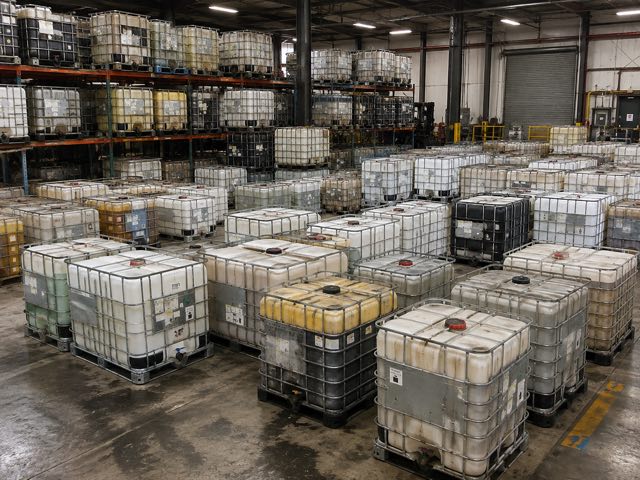
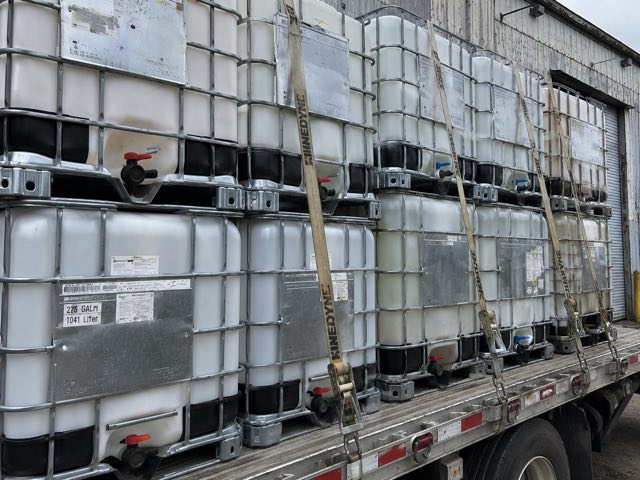
- UV damages impact strength long before the container looks damaged.
- A thumbnail across the sun-facing wall is a decent field test — chalk means degradation.
- Heat accelerates chemical permeation as well as UV damage.
- Coastal fog buys real time; inland Bay Area sites do not have that benefit.
What UV actually does
Polyethylene absorbs ultraviolet light in the 300 to 400 nanometre range, and the energy is sufficient to break carbon-carbon and carbon-hydrogen bonds in the polymer backbone. The resulting free radicals react with atmospheric oxygen, and the chain of reactions that follows shortens the polymer chains near the surface.
Three things happen as a result. The surface becomes chemically different from the bulk, which is what produces the chalky residue. The surface layer becomes brittle, because short chains cannot entangle and absorb energy the way long ones do. And micro-cracks initiate at the surface, which then propagate inward under ordinary service stresses.
The important consequence is the second one. The container does not develop a hole. It loses the ability to survive an impact it would previously have shrugged off — a forklift tine, a drop of six inches onto a pad, a shunt from another container. It fails suddenly, having looked fine.
How much life it costs
| Storage condition | Observed service life | Typical failure |
|---|---|---|
| Indoors | 10–15 years | Stress-crazing from cycling |
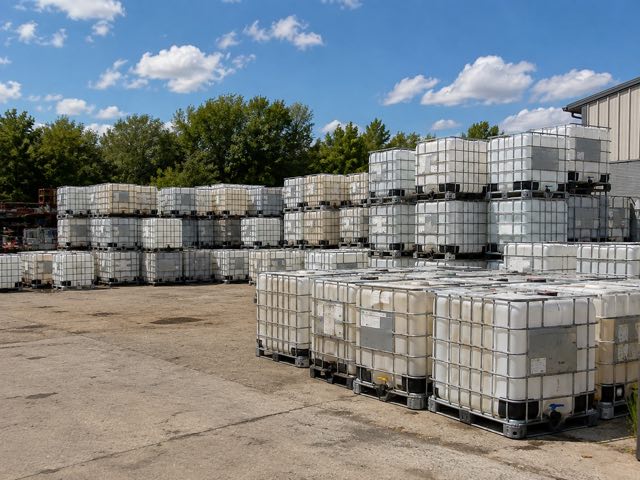
| Outdoors, UV-opaque cover | 8–12 years | Stress-crazing, some base corrosion |
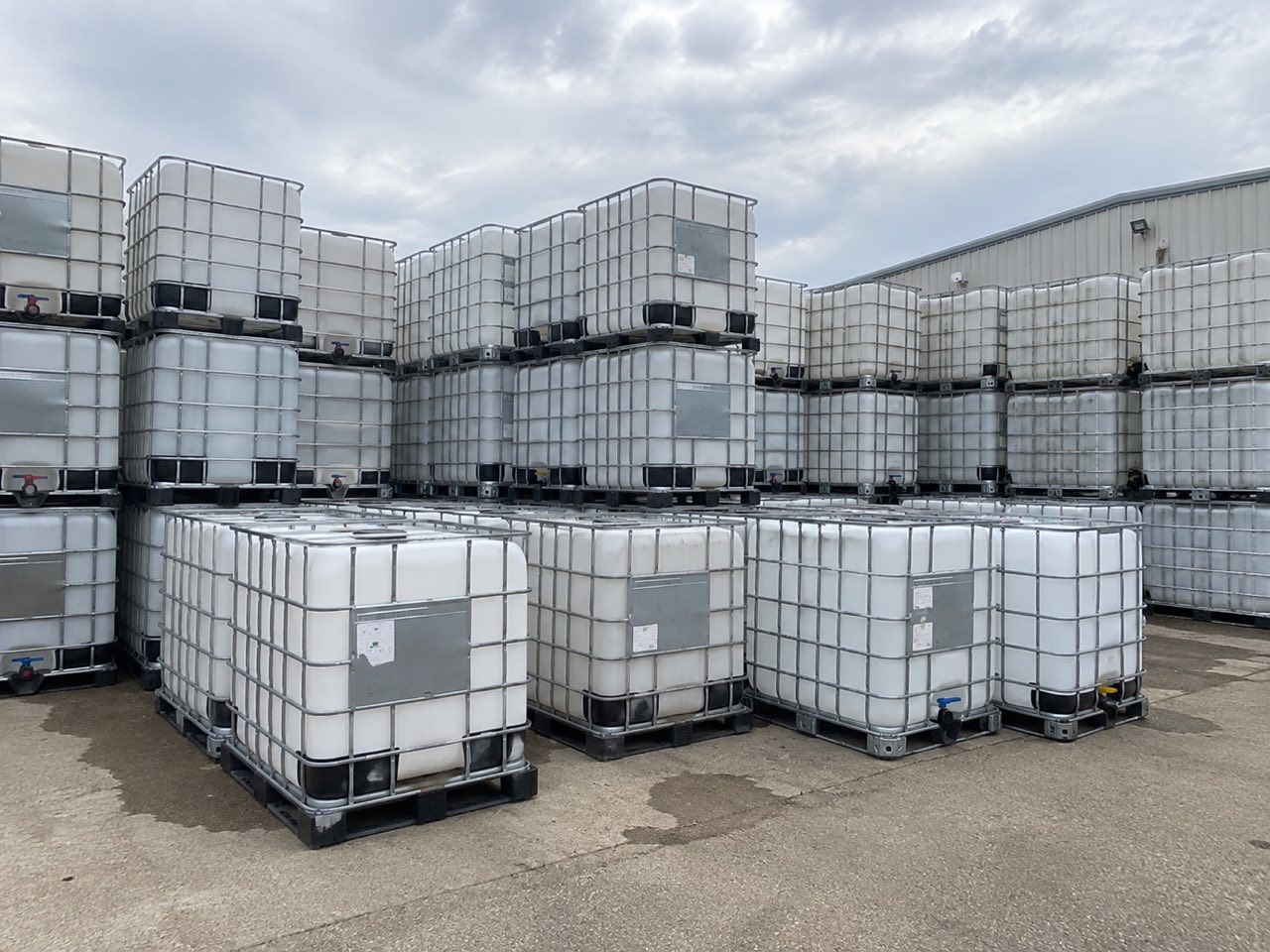
| Outdoors, shaded, uncovered | 6–9 years | Crazing plus surface embrittlement |
| Outdoors, uncovered, coastal | 5–7 years | Impact fracture on degraded surface |
| Outdoors, uncovered, inland valley | 4–6 years | Impact fracture, earlier |
The coastal-versus-inland difference is real and larger than people expect. San Francisco fog is genuinely protective — fewer clear-sky hours, lower surface temperatures, less thermal cycling. A container in Bayview and the same container in Livermore are having quite different summers.
Heat is a separate problem
UV gets the attention, but temperature does two things worth knowing about independently.
First, it accelerates permeation. HDPE is not a perfect barrier; small molecules migrate through the wall slowly, and the rate roughly doubles for every 18 °F. A container of solvent-adjacent chemistry in a sunlit yard at 110 °F is losing product and accumulating it in the wall considerably faster than the same container at 70 °F.
Second, it drives thermal cycling. A dark-surfaced container in direct sun reaches wall temperatures well above ambient, then cools overnight. The expansion and contraction is a stress cycle in its own right, and it is added to whatever fill-and-draw cycling the container is already doing.
The pressure consequence
A field test that takes ten seconds
Run a thumbnail firmly across the sun-facing wall of a container. If you get a chalky white residue on your nail, the surface has degraded. Compare with the shaded side of the same container — the difference is usually stark and it tells you how much exposure the unit has had.
That test does not tell you the container is unsafe. It tells you the impact strength is reduced, that it is on a shorter path to failure than a covered unit, and that it should not be the container you use for anything valuable or anything that will be handled roughly.
It is also the test I would apply before buying a used container from anybody. A dull, chalky, faded tote has spent years outside uncovered, whatever the seller says about its age.
Two measures that recover most of it
- A UV-opaque woven cover, $48. It addresses UV, it reduces peak wall temperature by shading, and it suppresses algal growth in stored water. Nothing else in this business has a return like it.
- Siting away from reflected heat. Containers against a south-facing metal wall or on dark asphalt run considerably hotter than the same containers on gravel with air movement around them. Free, and it matters more than people assume.
What does not work: painting the container. Paint adheres poorly to HDPE, flakes within a season or two, and leaves you with partial coverage and a mess. And shade from a tree is better than nothing but transmits substantial diffuse UV — it is not a substitute for a cover.
Written by Priya Raghunathan, wash chemistry & compliance at IBC Totes San Francisco. Published June 11, 2026. Spotted something wrong? Tell us — we would rather fix it than defend it.