The short version
- Seasonal use is the clearest case — a winery using totes eleven weeks a year should not own them.
- Outdoor storage costs more in container life than most operators count.
- Lease payments credit against purchase up to 60% of unit value if you change your mind.
- For year-round indoor use, owning is still the cheaper answer.
Forty-one accounts, one year
We started the leasing programme in 2023 mostly for harvest customers. Last year forty-one accounts moved from owning containers to leasing them, and the pattern in who moved is consistent enough to be useful.
| Segment | Accounts moved | Typical fleet | Typical saving |
|---|---|---|---|
| Wineries and cideries | 17 | 25–60 units, 11 weeks | 55–65% |
| Construction and site water | 9 | 6–20 units, 4–8 months | 30–40% |
| Event and seasonal food | 6 | 4–12 units, 3–5 months | 35–45% |
| Municipal and emergency stock | 5 | 20–80 units, staged | Varies |
| Chemical blending, campaign work | 4 | 10–30 units, 6 months | 25–35% |
Case one: seasonal demand
The clearest case by a distance. A winery owning forty food-grade totes has bought a fleet that works for eleven weeks and sits for forty-one. Amortised across a five-year life with weather losses, that is roughly $4,900 per harvest in container cost alone.
The same forty units on a harvest lease at $44 per month for three months is about $1,870, delivered, collected and food-line washed with certificates. It is not a marginal difference and it does not require anyone to be clever.
The second-order benefit is bigger than the first. Owning converts a variable requirement into a fixed cost, which is precisely the wrong direction when vintage size moves 30% year to year. A small vintage means you paid for containers you did not use; a big one means you are buying at the worst possible moment in late August alongside everybody else.
Case two: no storage, or the wrong storage
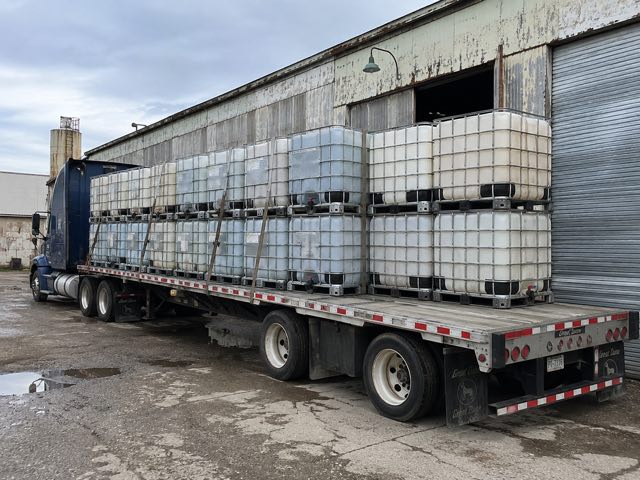
This is the one people undercount. Storing containers outdoors uncovered costs roughly half their service life — four to six years against eight to twelve — and in the North Bay and Central Valley it also costs four to six units a year outright to sun, frost and wind.
Add the land. A quarter acre holding a container yard nine months of the year is a quarter acre not doing anything else, and on a working site that is rarely free.
When customers add those two together the ownership case usually collapses on its own, without anybody needing to argue about lease rates.
Case three: the project that ends with a disposal bill
A construction contractor buys twelve totes for site water on an eighteen-month job. At the end they have twelve dented, sun-damaged containers on a site that is being handed over, and no plan.
Sometimes they call us and sell them back, which is fine and we pay a fair Grade C price. Often the containers get left, or dumped, or go to a transfer station at bulky-item rates. Leasing hands that problem back to us by design, and it is priced into the rate.
The bit people like
When you should still buy
- Year-round standing capacity with indoor or covered storage. Ownership is straightforwardly cheaper and the containers last their full life.
- Asset-tagged or UN-plated fleets you have qualified for a specific process. Keeping the same physical units is worth real money and toll reconditioning serves that better than leasing.
- Anywhere the containers become part of a fixed installation — manifolded arrays, bunded platforms, anything plumbed.
- Very small fleets. Below about four containers the lease administration is not worth anyone's time and you should just buy them.
And if you lease and then decide you want them: accumulated lease payments credit against the purchase price up to 60% of unit value. About a third of our leases end that way, which is fine by us — the container stays in service either way, which is the whole point.
Written by Wesley Kam, quote desk lead at IBC Totes San Francisco. Published November 6, 2025. Spotted something wrong? Tell us — we would rather fix it than defend it.