The short version
- Measure your lowest rack beam before you compare price per gallon.
- A full 330 weighs 2,897 lb with water — check the forklift, not just the floor.
- Never stack a 330 on a 275: the top rails do not align.
- For open floor storage with headroom, the 330 is straightforwardly the better buy.
On paper the 330 wins
Let me start by conceding the argument. A 330 gallon tote costs roughly 15% more than a 275 and holds 20% more liquid, on exactly the same 48 × 40 inch floor area. Cost per gallon is slightly better, gallons per square foot is meaningfully better, and you need six of them where you would have needed seven 275s — which is one fewer connection, one fewer transfer and one fewer opportunity to spill something.
If you are storing liquid on an open concrete pad with a ceiling you cannot touch, buy the 330. That is the honest recommendation and it is not close.
The seven inches nobody measures
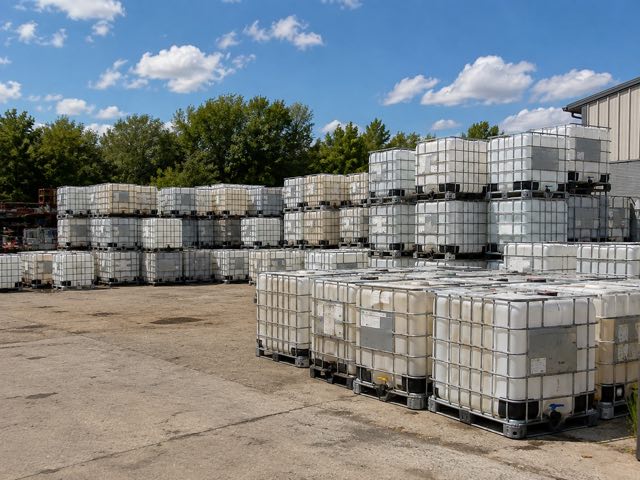
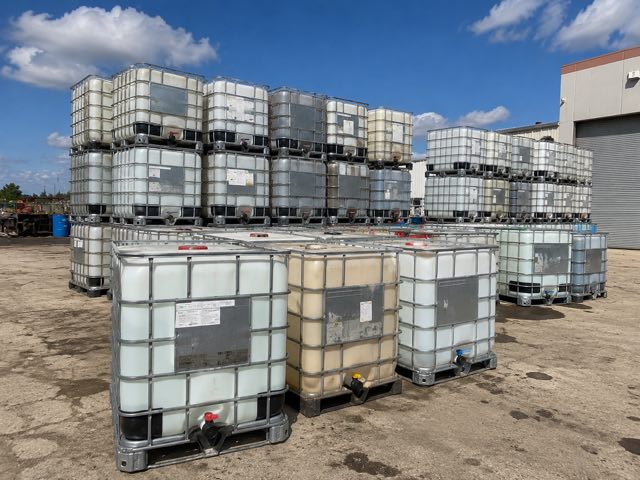
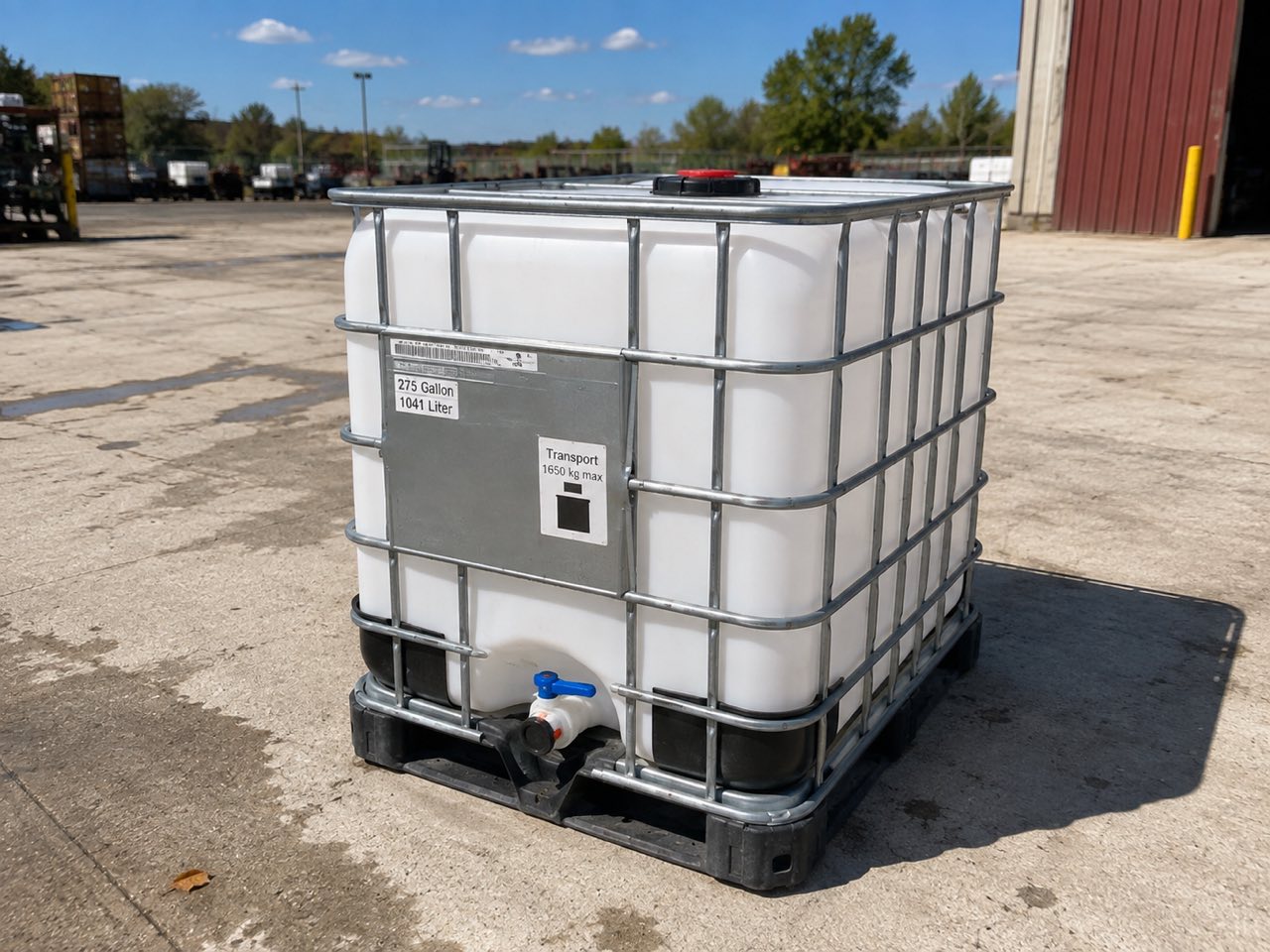
A 275 stands 46 inches tall including the cage and the pallet. A 330 stands 53. Both are 48 by 40 on the ground, which is why people compare them as though the only difference were capacity.
Forty-eight inches is a very common rack beam spacing. It is also a common shelf height, a common canopy clearance and a common threshold on older roller doors. A 275 clears all of it with two inches to spare. A 330 does not clear any of it.
| Constraint | Typical dimension | 275 gal (46 in) | 330 gal (53 in) |
|---|---|---|---|
| Standard rack beam spacing | 48 in | Fits | Does not fit |
| Roller door threshold, older buildings | 84 in | Fits on a forklift | Tight on a forklift |
| Box truck interior height | 96 in | 2 high | 1 high only |
| Double-stack under a 12 ft ceiling | 144 in | Comfortable | Tight with a forklift mast |
| Standard spill pallet sump volume | 66 gal | Adequate | Under-sized for the container |
That last row catches people even when the height is fine. Secondary containment is generally sized to hold the volume of the largest container plus freeboard. A two-tote poly pallet with a 66 gallon sump is comfortable under a 275 and under-specified under a 330. The footprint being identical makes it look like a drop-in replacement. It is not.
And it is 479 pounds heavier
Full of water a 275 grosses 2,418 lb and a 330 grosses 2,897. That extra 479 lb is enough to move a 3,000 lb forklift from "adequate with no margin" to "outside its envelope once you account for load centre." With anything denser than water you are firmly into 4,000 lb truck territory.
Racking has the same problem. Two 330s in a bay is 5,794 lb through one beam pair, against 4,836 lb for two 275s. That is a 20% increase on a component with a rated capacity that a great many warehouses have never actually checked.
The rule I give customers
When the 330 is clearly right
- Open floor storage with real ceiling clearance — the classic case, and it is a genuinely better product there.
- Outdoor pads and tank farms, where height is unconstrained and you are optimising concrete.
- Fixed-footprint bunding you have already built, provided you scale the sump volume as well.
- Operations trying to reduce handling movements: six containers instead of seven, every cycle, adds up.
And when it is clearly wrong: racked storage on 48-inch beams, box-truck delivery where you need two high, anywhere with an older roller door, and anywhere the forklift is a 3,000 lb machine that has been quietly doing more than it should for years.
What we do about it
We ask three questions before quoting a 330: what is the lowest rack beam, what is the narrowest doorway on the route, and what is the forklift rated at. Roughly one customer in four who asks for 330s ends up ordering 275s after that conversation, and none of them have come back to complain.
It costs us a little margin every time. It costs considerably less than a returned delivery, a crushed bottle or a customer who quietly stops calling because the last order did not fit through their door.
Written by Desmond Okafor, yard manager at IBC Totes San Francisco. Published August 6, 2024. Spotted something wrong? Tell us — we would rather fix it than defend it.