The short version
- Multiply gallons × 8.34 × specific gravity, then add the tare. Never assume water.
- Derate the truck for load centre and for lift height, in that order.
- A 550 gallon tote needs a 6,000 lb truck, not a 5,000 lb one.
- Tell your supplier about the dock before delivery, not on delivery day.
The single most common delivery failure
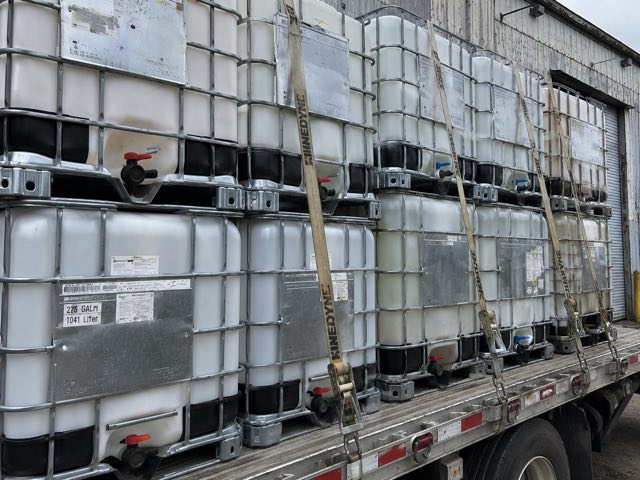
I book every truck that leaves this yard. Across a typical year the number of deliveries that go genuinely wrong is small, and the majority of those have the same cause: the receiving site cannot get the containers off the vehicle.
Sometimes that is because nobody booked liftgate service and there is no forklift at all. More often, and more expensively, there is a forklift and it is not big enough — and nobody finds out until it is under the load with the mast complaining.
What the capacity plate actually means
A forklift rated at 3,000 lb is rated at 3,000 lb with the load's centre of gravity 24 inches from the fork face, at a stated mast height, on level ground. Every one of those conditions matters and an IBC tote breaks the first one immediately.
A standard tote is 48 inches deep. Loaded evenly, its centre of gravity sits around 24 inches back — which sounds fine until you remember that the forks enter from the 40-inch side in most yards, or that the container is not always loaded evenly, or that the operator does not always get the forks all the way in. Real-world effective load centres of 28 to 32 inches are normal, and capacity falls roughly in proportion.
| Rated capacity @ 24 in | Effective @ 28 in | Effective @ 32 in | Safe for 275 gal water tote? |
|---|---|---|---|
| 3,000 lb | ≈ 2,570 lb | ≈ 2,250 lb | Marginal — no headroom |
| 4,000 lb | ≈ 3,430 lb | ≈ 3,000 lb | Yes, with margin |
| 5,000 lb | ≈ 4,290 lb | ≈ 3,750 lb | Yes, and handles 330 gal |
| 6,000 lb | ≈ 5,140 lb | ≈ 4,500 lb | Yes, and handles 550 gal |
Then there is mast height. Most trucks lose further capacity above a certain lift height, and the loss is not trivial — 10 to 20% is common at second-rack level. If you are putting full totes into racking, the number that matters is the capacity at that height with that load centre, not the number on the side of the truck.
And the load is heavier than people think
The other half of the problem is that everyone remembers "about 2,400 pounds" and applies it to everything. That figure is water. A great many things we ship are not water.
| Contents | Specific gravity | 275 gal gross | 330 gal gross |
|---|---|---|---|
| Vegetable oil | 0.92 | 2,235 lb | 2,677 lb |
| Water | 1.00 | 2,418 lb | 2,897 lb |
| Liquid fertiliser (UAN 32) | 1.32 | 3,152 lb | 3,777 lb |
| Cane syrup | 1.42 | 3,381 lb | 4,052 lb |
| Sodium hydroxide 50% | 1.53 | 3,633 lb | 4,354 lb |
| Sulphuric acid 93% | 1.83 | 4,321 lb | 5,180 lb |
A brewery that switched from drums to totes for 50% caustic came very close to a bad afternoon last year: their 3,000 lb truck, a 3,633 lb load, and a driver who assumed a tote was a tote. We caught it during the site check and shipped at 80% fill instead. That conversation is why we now ask about handling equipment on every new commercial account.
What to do if the truck is too small
- Book liftgate service. Sixty dollars, handles up to four totes at a time on a hydraulic tail, and requires nothing from you but a level place to set them down.
- Order smaller. Two 275 gallon totes weigh less individually than one 330, and considerably less than a 550. Floor space is usually less scarce than lifting capacity.
- Ship at partial fill. We do this routinely for dense chemistry. It costs a little more per gallon delivered and it is far cheaper than an incident.
- Fill on site. Take the container empty at 125 lb and fill it where it will stand. Obvious once said, and frequently the right answer.
- Rent a bigger truck for the delivery window. For a one-off large order this is often cheaper than any of the above.
What we ask, and why you should have the answers ready
When you request a quote, five answers make the difference between a delivery that takes twenty minutes and one that costs everyone a morning.
What is the forklift rated at, and at what load centre?
The data plate, not the model number. If you do not have a forklift, say so and we book a liftgate.
What is going in the containers?
This gives us the specific gravity, which gives us the real weight, which tells us whether your truck is adequate.
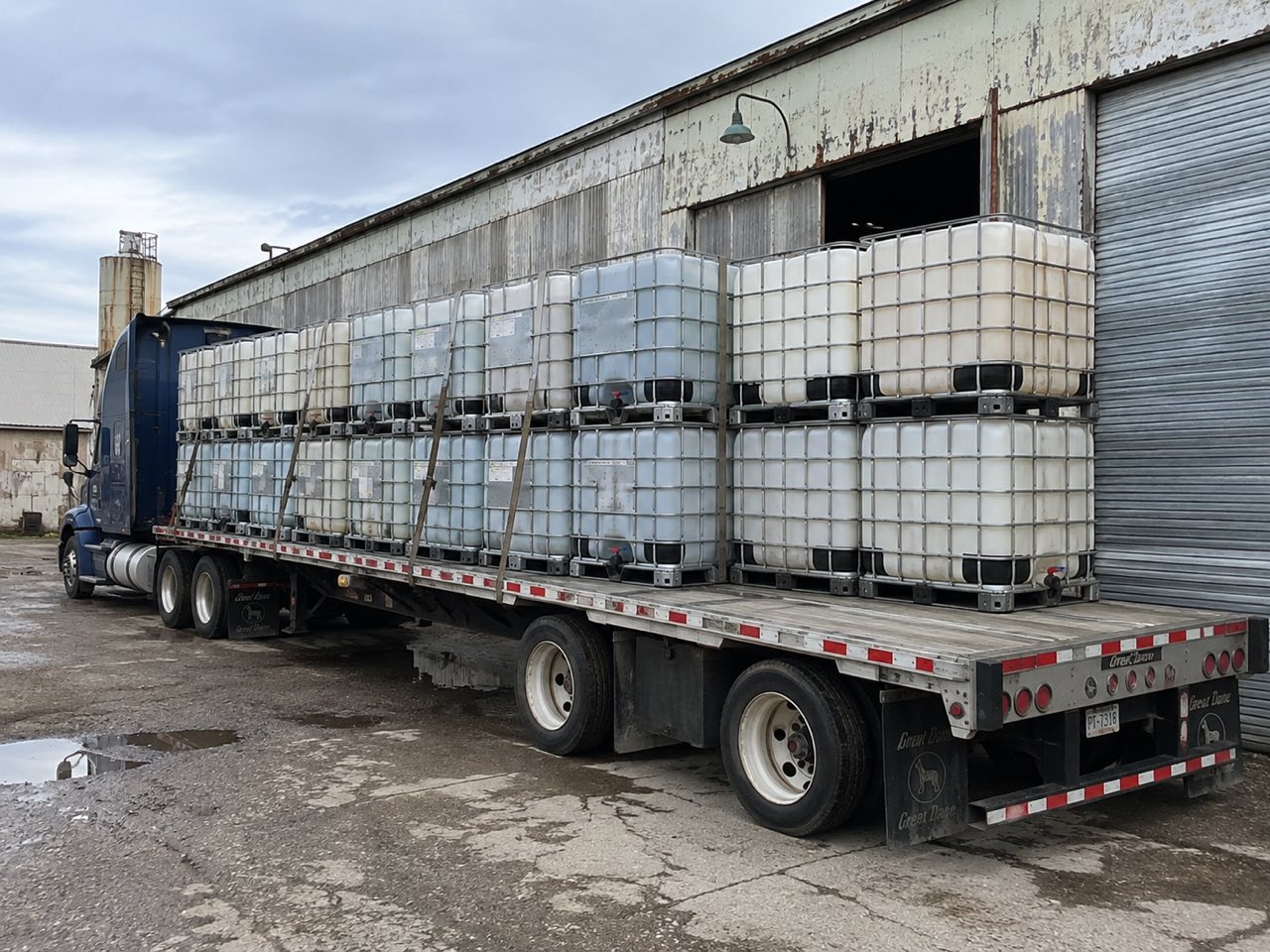
Can a 53 ft flatbed reach the unloading point?
Turning radius, gate width, overhead wires, and whether the street allows it. San Francisco in particular has defeated experienced drivers.
Is the unloading surface level and load-bearing?
Gravel is fine. A sloped driveway with a full tote on a pallet jack is not.
What are the delivery windows?
Especially if there is a shared dock. Waiting time is the one charge nobody enjoys explaining.
Written by Ingrid Halvorsen, freight & logistics at IBC Totes San Francisco. Published June 19, 2024. Spotted something wrong? Tell us — we would rather fix it than defend it.