The short version
- Every IBC bottle is food-grade resin. The resin was never the question.
- Ask for the prior product, the shipper and a wash record — in writing.
- There is no transferable "food grade certificate" for a second-hand tote.
- If the history cannot be named, the container is industrial at best.
Why the phrase is on every listing
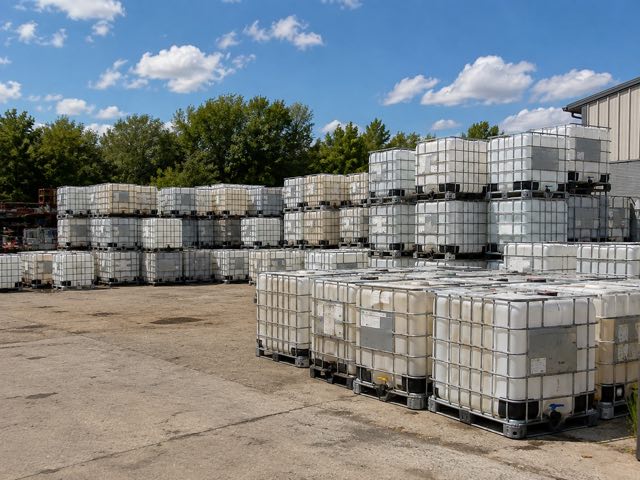
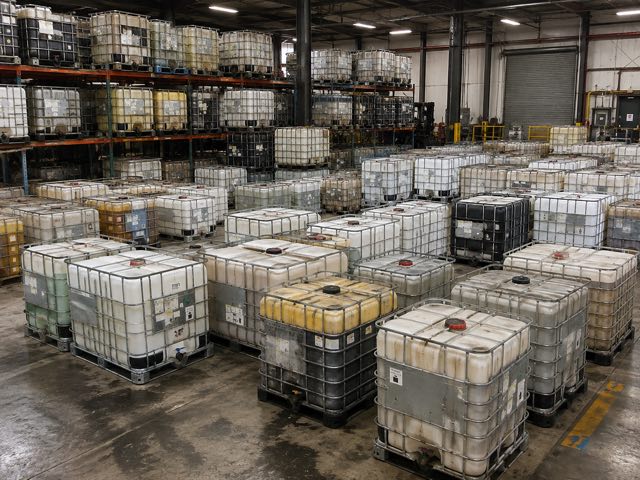
Search any classifieds site for used IBC totes in this region and you will find dozens of listings that say "food grade". Most of the people writing them are not trying to mislead anybody. They are repeating something true.
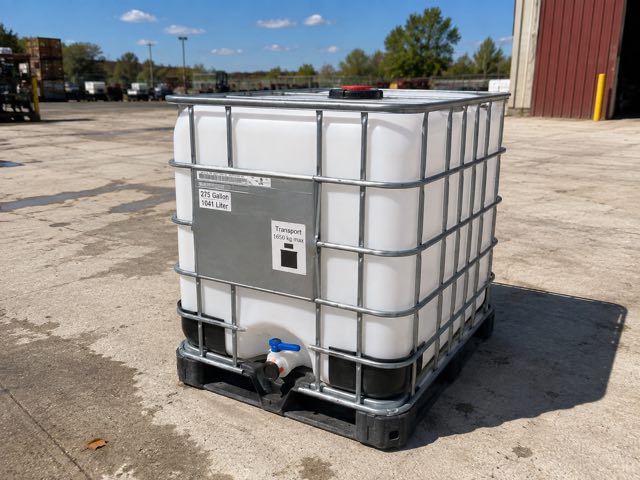
The bottle in a composite IBC is blow-moulded from high-density polyethylene that meets FDA 21 CFR 177.1520 for food contact. That is true of the bottle that carried cane syrup and equally true of the bottle that carried a surfactant blend. Nobody manufactures a separate, inferior resin for industrial containers — it would cost more to run two resins than to run one.
So "food grade plastic" is a statement about the material, and it is always true. The buyer hears a statement about the container's history, which it is not.
What actually determines whether you can use it for food
| Question | What a listing usually says | What you need |
|---|---|---|
| What resin is it? | "Food grade plastic" | Irrelevant — always yes |
| What was in it before? | Often nothing, or "clean" | A named product and, ideally, a named shipper |
| How was it cleaned? | "Rinsed" or "pressure washed" | A wash on a line that never sees industrial containers |
| Can you prove either? | No | A prior-contents record and a wash certificate |
Cross-contamination in this industry happens through shared equipment, not insufficient scrubbing. A hot caustic wash is very good at removing product; it is not good at removing the consequences of a hose that carried solvent residue an hour earlier. That is why our food line has its own bays, hoses, gasket stock and staff rotation, and why an industrial container physically cannot enter it.
A seller washing containers in a yard with one setup cannot make that claim, however carefully they work. It is not a criticism of their diligence. It is a fact about the equipment.
The certificate that does not exist
Occasionally a seller offers a "food grade certificate". Ask who issued it and against what standard. There is no body that certifies second-hand containers as food-grade, and there is no transferable document of that kind in this industry.
What a reputable reconditioner provides is two records, both of which name their source: a prior-contents record tied to a unit number, and a wash certificate stating the line, the process and the date. Those are the actual artefacts. We hand them over with every food-grade unit and we will show you the format before you buy.
A fair test
This is not an argument against buying privately
I want to be careful here, because it would be easy to read this as "buy from us instead". For a great many uses, a container off a classifieds site is a perfectly sensible purchase. Rainwater for ornamentals, ballast, storage, a planter, dust control on a site — go and buy the $80 tote from the farm down the road.
The line I would draw is anything that ends up in a person: food, beverage, potable water, cosmetics, anything you will ferment. For those, the history is the product, and a phrase in a listing is not a history.
And if you have already bought one and are not sure: send it to us for a food-line wash with a certificate. It is $72. What we cannot do is manufacture the prior-contents record retrospectively, so if the history is genuinely unknown, use the container for irrigation and buy a documented one for the product.
Written by Marisol Trejo, founder & managing partner at IBC Totes San Francisco. Published April 30, 2025. Spotted something wrong? Tell us — we would rather fix it than defend it.